
I've moved my blog to WP: idefiningi.wordpress.com
Showing posts with label moving. Show all posts
Showing posts with label moving. Show all posts
March 18, 2017
adjust (v.)
I’ve been back in Vancouver for almost four weeks now. It took me some time to get adjusted, and I still think I’m adjusting. When I got off the plane, I made my way through Customs (with a slight uncertainty about whether to mark the ‘resident’ or ‘visitor’ section of the landing card, knowing well that I am not officially a BC resident yet). The main feeling I had was excitement, as it bubbled through me, knowing Jason was on the other side. Some anxiety surfaced as well, of course – and at brief moments, a sinking feeling.
We hurried ourselves through the airport and out, in our own way fleeing this reminder that I had actually arrived from London – the airport and all my suitcases was a direct call out to the fact that I had actually been there, that long. We talked like no time had passed, though, pushing the cart, discussing the flight and the movies I had watched, what I ate. We then were paused for a moment, in semi-awkward silence, by the parking attendant, waiting for him to wave a green light for us to cross into the parkade.
In the parking lot, I looked at him and the hustle of the task that was my airport pick-up dropped away. I felt heavy and an exhaustion from the idea of going back into Vancouver. I sunk a bit.
London was far behind physically, but having closed the door on that chapter now, the magnitude of the thousands of incredible moments of my last 18 months had huddled into a single memory: Dense with adventure and learning and joy, yet somehow less accessible in mind. In an instant, a year and a half of experiences turned into a single cloud of some one thing that had happened, my mind best recalling what my room on Croftdown Road looked like, emptied of my belongings, suitcases on the floor. I gulped away an oncoming tear, then reached out. We hugged for a long time.
Standing there in his arms by his car, I muttered, “I could do this forever. Can we do this forever. I don’t want to go anywhere. Let's just do this forever,” holding him tight.
And in the kind of way that only Jason knows how, he replied, “Yes, yes we can. But it costs a dollar for every 10 minutes.” I laughed into his chest and just like that I was light again, the tension gone. A warmth settled in me and I knew, at worst, he’d make me laugh through whatever awaited me.
adjust (v) from Late Latin adiuxtare "to bring near”


November 5, 2016
dance (n., v.)
I’ve taken many a leap in coming here - to London, and to every unfamiliar experience and mysterious space that I’ve explored over the last year. But tonight was the first time that I consciously realized what it is to have leapt not in a singular direction, but simply, outward. It’s what I’ve done here gradually, and it really hit me today.
I just came back from my second 5Rhythms class, what I foresee becoming a Thursday night ritual that begins and ends with a thirty minute walk to and from a lovely church in Holloway. What occurs in between, I’ll venture to describe as a kind of reverie of movement.
I won’t get into specifics (you can google it), but I will share some reflections, having just come out of a class, glowing with sweat, tired and empty yet quite full and very much alive.
We hold emotions in our body; that’s something I’ve slowly come to realize in my mindfulness practice. When we’re still, we become aware of this and vipassana has taught me the benefit of observing the physical manifestations of emotion to help us detach from it. When we move - consciously - through yoga, any meditative exercise, dance - I think we allow this energy to be released, harnessed, expressed and given form; shaped into something that is more than just ourselves - and that too, helps us detach a bit.


The 5Rhythms class isn’t really all that structured, yet there is a method to the madness as about forty people of all ages and sizes flail around freely in the open space in all sorts of contortions and shapes. The movements - whatever the movement - fall into one of the 5 bodily rhythms (what I think are intrinsic and quite natural for us to dance to when we let go): flowing, staccato, chaos, lyrical and stillness - and these give the mess of bodies a form. We move as separate beings, often with eyes closed, usually not touching, yet we manage to fill the spaces in between each other - with our energy.
I recall my first class last week, when I first walked in to the dim lit church, the high ceilings punctuated with strings of small lights hanging across from each wall. I admired the space. And it took some time, as people started moving to the undulating music playing, to admire not each dancer, but the group as a whole. As the music picked up, and the movements became more pronounced, it was a welcome challenge for me to drop judgment, of others and myself. To stop caring what it all looked like but instead dance with the passive intention to fall into the wave, be carried by it, until all I could is just feel it.
The music plays and we move along to the crescendo, uplifted and lifted and further lifting until we give way to the gradation of rhythms that brings us back to stillness as the music slows down.
One thought I had, as I sweatily rocked from side to side, my arms limp until I had stopped moving altogether: Even stillness is movement, it is the essential pause between one action to the next; except we are more conscious of it. Dancing, I think - when we shed the vanity and the tempting performative aspect of it - is really a tuning into the stillness that creates a rhythm. Sometimes the rhythm is too quick for us to meditate on it, but it’s there. And when we dance, we are aware of it, just not as actively. Perhaps that’s what eventually leads us to fall into trance (from Latin transire “cross over”, associated with the word transient) - when we can follow along deeply enough that we not only dance to the sound but to the silences in between, bridging them with our body.
I found it somewhat odd that the word dance itself - from Old French dancier - is of unknown origin, posited to have come from Low Frankish dintjan, “to tremble, quiver.“ Somewhat melancholic an etymology, but perhaps not surprising given (says google result from Live Science): “dancing was a way for our prehistoric ancestors to bond and communicate, particularly during tough times.”
Previous to “dance”, the word sealtian (Old English) was used, from the Latin salire, “to leap”. Interestingly, this is associated with the word salient, whose denotation of describing something "prominent, striking” was first recorded in 1840, from “salient point” (1670s), which refers to the heart of an embryo, as it seems to leap.
And there it is, what I felt all along. A leaping out of myself, a cognition of my centre, my heart, which with each movement found its way to beat more outward, seemingly synchronised with the music. Sometimes as the music played and I moved with it, it was hard to tell whether it was me dancing along or the music responding to my movements. A sort of mirroring to the point that it’s hard to separate the two. I searched further on google on the origins of dance and quickly learned that our ability to dance to a beat comes from our unique ability (that we only share with some birds, not even apes) - to mimic sound.
And last but not least as I go further down my wormhole…. a beat in music is defined as “a transient grace note, struck immediately before the note it is intended to ornament. The beat always lies half a note beneath its principal, and should be heard so closely upon it, that they may almost seem to be struck together.” [The British Encyclopedia, London, 1809]
And there you have it. A bunch of chaotic ideas that thanks to a burst of momentum, I’ve wrought into flowing form through the interconnectedness of words, a lyrical dance of sorts, slowly coming
September 21, 2016
whimsy (n.) or "dream spotting" (vb.)

Yesterday, after a lovely walk through Soho with my friend Jen who was visiting from NY, we spotted an umbrella in a tree. Reality check.
This practice, while helping me to achieve lucidity while dreaming, has also made me achieve a certain kind of lucidity when in the waking state. Every time I reality check, my heart also flutters a bit, excited by the whimsy of this incredible world. Even when awake, dream-like things can happen. If we awaken to them.
Take today for instance: A regular lunch-hour. I decided to walk myself with a cup of tea and a book to a very special spot by Hampstead Heath station, a few minutes from my work: The World Peace Garden. It’s a community-build space where people can come and sit and be in nature, amidst dreamy decorations of colourful notes pinned and fluttering in the trees, painted plant pots and laid out tree stumps for sitting, and wind chimes that somehow sound louder than the nearby trains that come into the station adjacent to the garden.
I made my way down the narrow little path, under the carved wooden sign reading ‘World Peace Garden’ and down a few steps and toward the ‘tree’ (though it’s all mostly trees). It’s sort of like a hut, demarcated by logs and stumps; the chimes and notes that I mentioned hang from various branches that have been strewn across the top to form a kind of thatched teepee roof. Almost a fake tree made of trees, if you will. And in the middle, if you’re creative, you can manage to find a way to plop yourself down in such a manner that it feels like a throne. I sat and took out my book and began reading.
Some time passed and a man approached me. Grey-haired, well-dressed, white collared shirt with sleeves rolled up, approaching me with clear eyes and a confident voice. I can’t quite recall what his opening line was, but it was enough to lift my eyes from the page and inspire in me an openness to the sudden interruption. I greeted him and agreed to listen to a story he wanted to share with me “about the Peace Garden.” Or rather, “a legend” as it were - The Legend of the Woman in the Tree.
The legend wasn’t much, but a simple description of the garden’s cardinal rule, that should one see ‘The Woman in the Tree’, one must approach her and ask her a single question.
“And since you are just that, the first I’ve seen, The Woman in the Tree, can I ask you a question? You must give a single reply.”
Of course, I said. And then he began.
“Why do I wake up and can’t sleep through the night?“
I pondered it a while, but an answer quickly rose to my lips and with a smile I said, “Because you’re dreaming.”
Having been experiencing much of the same thanks to my lucid dreaming practice (whereby I’d often awake after a dream, in the middle of the night, sometimes many times over, after each REM cycle). It’s as if your mind is telling you, ‘Wake up so that you remember.’ And so I’d awake, and remember what I had dreamt. And then go back to sleep, affirming in my thoughts a desire to become lucid.
The man smiled and seemed a bit perplexed. He promised he’d give it some thought. Think it over. “Thank you.” And before he walked off he reminded me, “ Remember now, if someone comes up to you with a question, you’ll know why. You’re the Woman in the Tree.”
And I guess I was. Soon, with a flutter in my heart, I returned to my book, asking myself if I were dreaming.
whimsy (n.) From whim (n.) “a sudden turn or inclination of the mind”, shortened form of whimwham, circa 1520s, unknown origin - perhaps from Old Norse hvima “to let the eyes wander,” or Norwegian kvima “to flutter”.
I wasn’t. But the whimsical quality of the moment stayed with me. And enough so that on my walk back to the office a little bit later, I noticed another anomaly: A bunch of papers stuck into the side of a plant pot, outside the White Horse pub. I read the first page visible.
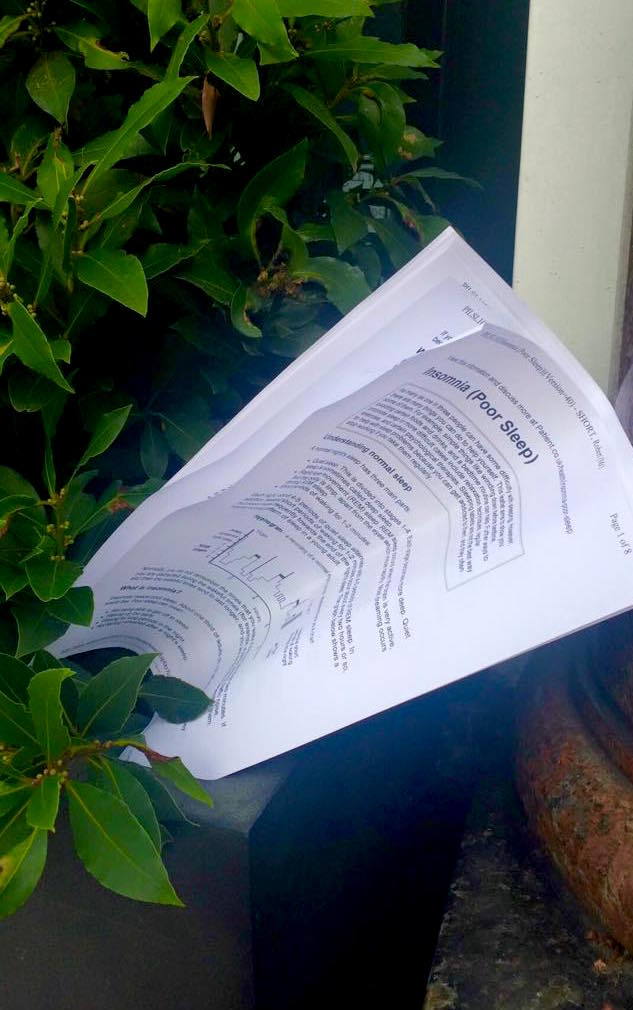
Oh, and the book I’m reading? The People in the Trees by Hanya Yanagihara.
[Originally posted as part of my life.actually adventures]
March 30, 2016
alone (adj., adv.)
alone (adj., adv.) from Old English all ana “unaccompanied, all by oneself”Apart from having a lot of time to myself in London surrounded by new friends, I’ve also spent some time by myself exploring other cities as well - cities like Vienna, Dublin, Berlin and Copenhagen. All these trips have involved visits with close friends, yet even so, I’ve still been quite aware of my unique, very personal, lone experience outside the shared experience, (which I of course cherish).
As I’ve gotten older and past my mid-twenties, I realized a noticeable shift towards relishing in experiencing things with myself. I value others no less; I think I just value myself more.
Even at times when my aloneness turns to loneliness, I remind myself I am not by myself. I remind myself I have a special moment - to be with myself. And these moments are truly sacred.
This is all quite opposite to how I once dealt with aloneness. I had fears of being alone for many years. And not necessarily fears of just being “alone" in life in general but of being “by myself” at any given time and space.
 |
| From an exhibit at the Tate Modern, "Performing for the Camera," exploring the ways in which we perform and manipulate who we are even in modes that appear to be realistic, voyeuristic, documentarian. |
A very extroverted person, I put in many efforts to be constantly with and around people. It was always easy for me, as I don’t get anxious around new people, groups, and I find it rather easy - and enjoyable - to “organize” other people into my life. I’ve also been very fortunate to have a really strong circle of people around me to draw from, in my eager mission to share my time with others, preferably loved ones.
Of course, I didn’t just pull others in to share in joyous experiences. At times of difficulty, indecision, restlessness or anxiety, I’d instinctively reach straight out to a friend or parent to grasp them for blind support, to pull them in so that I didn’t have to feel out the situation all on my own - and at certain times, to drag them right down with me because I didn’t have the clear judgment required to allow them to pull me up.
Oftentimes, it would all turn unnecessarily dramatic or would sap us both of energy because I couldn’t present a fair picture of what was wrong. And why? Because I hadn’t spent any time really assessing the picture more objectively for what it truly was. Many times the problem was me rather than the situation, or at least, it was much more simple than it seemed from the centre of my emotional storm. And how are we to ever have this clarity if we don’t take a moment to reflect?
For some people it’s harder to make room for time to be with themselves, especially at times of difficulty. I was one of those people. But in some ways, being forced to take things on (physically) alone, by moving out alone a few years ago, moving away alone more recently, and moving around as a traveler alone in spurts over many years, has taught me to appreciate being
No one can bring more insight to an experience you are living than you. By taking moments to listen to our inner thought processes, by spending time observing our given situations, we build more perspective on the situation and on ourselves in it. In a way, we make ourselves the object rather than the subject.
ye (pron.) Nominative plural of 2nd person pronoun þu (thou); Interestingly, the article ye was in fact an archaic way of writing the (þe), where the “y” character replaced the “thorn” (þ, representing the sound “th”), to accommodate printers at the time.I’ve learned to love to be with myself even when it’s tough. And I’ve learned to volunteer the time to be with myself and reflect, which has made me more attune to my feelings and where they’re really coming from. It enables me to find out what I can actually do about a difficult situation - if anything - before I engage someone else. And if I find that I can’t figure it out on my own, I know I am far more likely to be objective - and receptive - about another’s opinion when I do reach out.
National Express bus from Luton, March 28th, 9:55pm.
Originally posted on life.actually.tumblr.com.
January 1, 2016
solution (n.)
[Originally published on my Life Actually blog, one day into 2016, GMT.]
In some ways, it doesn’t feel like the end of a year. One part of it may be because I feel like I cut a new chapter in November and so it doesn’t quite feel like something new is beginning.
Some part of it may have to do with the fact that despite all my efforts, I got sick on Dec 31st thanks to a string of big nights out (I’m talkin’ 10am returns home) around Christmas. I wound up mostly staying in (at least by the city’s standards), having the mellowest NYE to date. I woke up with a sore throat and wound up on the couch at my roomie Tara’s parents place, reading and drinking mulled wine under the Christmas lights, then falling asleep for three hours to the sounds of Ben Hur on the TV. I eventually made it home with Tara where we continued with the lounging and lemon tea drinking, and after a short ringing in of the new year with my dad and his friends down the road, I walked home, had a bath and went to bed. Somewhat disappointing given that I’m finally living in a city that really knows how to ring in the new year; but at the end of it all, it’s all the same; another arbitrary night in the calendar, marked there to remind us to reflect on a period of time and create some intentions about our future.
I feel I’ve been doing this kind of thing, this reviewing and reflecting, non-stop since I moved here, though, so no hard feelings in retrospect. It’s been an active process for me for the last, dare I say, year - and this is something I want to emphasize as I create my “resolutions” for 2016. And by resolutions, I mean re-solutions.
So much of our life is bound by habit. What we do repeatedly becomes our life. For this reason, I think the best resolutions we can make are those that make us question the things we do that take up a whole year’s time (and eventually a whole lifetime).
What is the substance of our year that forges our long-term outcomes? How do our repeated ways of behaving/reacting reflect our embedded ways of thinking? It should be about challenging ourselves to leave particular patterns behind so we can reinvent and solve our current discomforts, problems or tribulations.
Diminishing our philosophy of life to a “list of resolutions” is amiss; it’s an active evolution not a line-up of dead-end intents and attempts (and eventual surrenderings).
In light of this, I’m looking at last year’s resolutions to see what I can take from them, regardless of their ‘status’ or ‘expiry.’
(Of course there are 10.)
1. Travel to 5 new places. I realize now you can see new places every day without going anywhere. Really. (For example, even after 20 years of living there, I saw Vancouver for the first time this year in many ways.)
2. Get more of my work published. I realized all I really wanted was to write freely, maybe move someone with my words - even if it was just me.
3. Move to a new city to bring visible changes in my life. I realize now it wasn’t so much about learning to adapt to a new place as it was about seeing what parts of me wouldn’t change.
4. Keep running to stay healthy and fit. I’ve learned that fitness is not an end in and of itself, but rather a byproduct of and catalyst for emotional wellbeing. Excercise helps me stabilize my thoughts and emotions and I’m getting better at making the sound decision to exercise even when I’m not feeling mentally and/or physically up for it, which is a challenge.
5. Keep a gratitude journal - and I did. But I learned that showing gratitude is more essential.
6. Take professional development courses. I learned that you need to apply new knowledge to actually learn it though. One way I did this, when lacking the option at work, was by teaching it to others.
7. Save $7,000. This as an arbitrary number, but as far as arbitrary savings goals are concerned, any number is better than zero. You never know when you may need to cash in; what important time it’ll buy you later; what act of desperation it’ll quell, what peace it will give you (unfortunately, but realistically) that will help you make the better decision.
8. Read a minimum of 12 books. In the last six months, I’ve read only half of two. And these have made more difference than a fat pile of top 100 listers. (Infinite Jest, A Guide to the Good Life)
9. Get closer and more deeply connected to my parents and my closest friends. In the process, I made friends out of my parents, I fell in love with a friend, and I certain friends became like family.
10. Do something out of my comfort zone. I chose bellydancing, which culminated in a performance in front of 350 people. Suffice to say, trying something out of your comfort zone doesn’t bring it into your comfort zone. It just makes you see how well you handle discomfort.
For the first time, my new years resolutions aren’t top-of-mind or clear to me. Perhaps it’s because the plates have shifted so much below my state of being with this move to London that everything feels like a new habit to be formed. I am reconfiguring a lot of myself this year…so in a year’s time, all I ask of myself is that I do this mindfully, gently, thoughtfully. That’s all; and it’s a whole lot.
In some ways, it doesn’t feel like the end of a year. One part of it may be because I feel like I cut a new chapter in November and so it doesn’t quite feel like something new is beginning.
Some part of it may have to do with the fact that despite all my efforts, I got sick on Dec 31st thanks to a string of big nights out (I’m talkin’ 10am returns home) around Christmas. I wound up mostly staying in (at least by the city’s standards), having the mellowest NYE to date. I woke up with a sore throat and wound up on the couch at my roomie Tara’s parents place, reading and drinking mulled wine under the Christmas lights, then falling asleep for three hours to the sounds of Ben Hur on the TV. I eventually made it home with Tara where we continued with the lounging and lemon tea drinking, and after a short ringing in of the new year with my dad and his friends down the road, I walked home, had a bath and went to bed. Somewhat disappointing given that I’m finally living in a city that really knows how to ring in the new year; but at the end of it all, it’s all the same; another arbitrary night in the calendar, marked there to remind us to reflect on a period of time and create some intentions about our future.
I feel I’ve been doing this kind of thing, this reviewing and reflecting, non-stop since I moved here, though, so no hard feelings in retrospect. It’s been an active process for me for the last, dare I say, year - and this is something I want to emphasize as I create my “resolutions” for 2016. And by resolutions, I mean re-solutions.
solution (n.) from solvere "to loosen, dissolve; untie, release, detach; depart; unlock; scatter; explain; dismiss; accomplish; remove,“ from PIE *se-lu-, "to loosen, divide, cut apart” (see lose).
So much of our life is bound by habit. What we do repeatedly becomes our life. For this reason, I think the best resolutions we can make are those that make us question the things we do that take up a whole year’s time (and eventually a whole lifetime).
What is the substance of our year that forges our long-term outcomes? How do our repeated ways of behaving/reacting reflect our embedded ways of thinking? It should be about challenging ourselves to leave particular patterns behind so we can reinvent and solve our current discomforts, problems or tribulations.
“We’re creatures of habit and we’ll get used to anything. I want to make sure I get used to the right things in this life. And however fast or slow it moves, one day, we’ll all eventually agree that it went by too fast. [Year by year, day by day, but really, all gone in a single blink.]” - me, 2 months ago
 |
| The years melt into each other... |
Diminishing our philosophy of life to a “list of resolutions” is amiss; it’s an active evolution not a line-up of dead-end intents and attempts (and eventual surrenderings).
In light of this, I’m looking at last year’s resolutions to see what I can take from them, regardless of their ‘status’ or ‘expiry.’
(Of course there are 10.)
1. Travel to 5 new places. I realize now you can see new places every day without going anywhere. Really. (For example, even after 20 years of living there, I saw Vancouver for the first time this year in many ways.)
2. Get more of my work published. I realized all I really wanted was to write freely, maybe move someone with my words - even if it was just me.
3. Move to a new city to bring visible changes in my life. I realize now it wasn’t so much about learning to adapt to a new place as it was about seeing what parts of me wouldn’t change.
4. Keep running to stay healthy and fit. I’ve learned that fitness is not an end in and of itself, but rather a byproduct of and catalyst for emotional wellbeing. Excercise helps me stabilize my thoughts and emotions and I’m getting better at making the sound decision to exercise even when I’m not feeling mentally and/or physically up for it, which is a challenge.
5. Keep a gratitude journal - and I did. But I learned that showing gratitude is more essential.
6. Take professional development courses. I learned that you need to apply new knowledge to actually learn it though. One way I did this, when lacking the option at work, was by teaching it to others.
7. Save $7,000. This as an arbitrary number, but as far as arbitrary savings goals are concerned, any number is better than zero. You never know when you may need to cash in; what important time it’ll buy you later; what act of desperation it’ll quell, what peace it will give you (unfortunately, but realistically) that will help you make the better decision.
8. Read a minimum of 12 books. In the last six months, I’ve read only half of two. And these have made more difference than a fat pile of top 100 listers. (Infinite Jest, A Guide to the Good Life)
9. Get closer and more deeply connected to my parents and my closest friends. In the process, I made friends out of my parents, I fell in love with a friend, and I certain friends became like family.
10. Do something out of my comfort zone. I chose bellydancing, which culminated in a performance in front of 350 people. Suffice to say, trying something out of your comfort zone doesn’t bring it into your comfort zone. It just makes you see how well you handle discomfort.
For the first time, my new years resolutions aren’t top-of-mind or clear to me. Perhaps it’s because the plates have shifted so much below my state of being with this move to London that everything feels like a new habit to be formed. I am reconfiguring a lot of myself this year…so in a year’s time, all I ask of myself is that I do this mindfully, gently, thoughtfully. That’s all; and it’s a whole lot.
December 8, 2015
vantage (n.)
[Originally written for Life.Actually]

It’s officially been one whole month since I left Vancouver and though I’ve been reflecting a lot, I thought it was about time I reflected more constructively on what I’ve learned since I arrived - about myself, what I want out of this move, and out of life in general. Funnily enough, today I went up to Sky Garden on Fenchurch Street and by getting a new vantage point of the City of London, it also got me thinking about my own perspectives on things since I’ve arrived here.
I always told myself that the success of this journey of mine didn’t really depend on “success” - that even failure would be a learning that would uncover something beneficial, even essential. So far, I am still unemployed (no surprise there though), though I’ve done quite a bit of work already - on myself.
Here’s what I’ve been working through over the last few weeks. (The first week was a bit of a shock to the system and my primary realization was that I cope pretty well with change….so long as I remember to slow down - slow down long enough to process and write (and get enough sleep)).
1. Life is work. And a work of art. Balancing life and work is really about integrating them rather than separating them. Even if we slice up our days and still call it “work-life balance,” in the long run, they are one. It takes effort to live fully, and well, and to play; but in the end, the quality of our time here is a consequence of how hard we worked to live a good life (read that in any way you wish).
2. My extroverted tendency is very ambivalent. I’ve enjoyed investigating my desire for privacy versus my need to recharge from being around others (and who those others are plays a huge part, too). I am much more mindful of my time, and when I share it with others I’ve found I’m focusing more on moments rather than seeing “the relationship” as a function of accrued time. This is likely because I’m meeting all sorts of people with whom I haven’t had lots of time to accrue in the first place. I’m realizing in many ways this is how deeper, more meaningful - not necessarily long-term (and that’s okay) - relationships form: with moments, rather than repeated time together. This wasn’t as obvious before as it’s been a long time since I’ve had to put in such efforts to make new friends. I’ve been much more mindful of each experience as these are more prominent than the “history” I have with each person here (which in most cases is non-existent).
I’d like to apply this lens, of having relationships more moment/experience-oriented, with new and existing friendships more. The people I miss most from home - and from the past and in my life in general - are those with whom certain deep, experiential moments of growth stand out. Some moments require an investment of time, of course. It’s about striking a balance between these two outlooks; and it begins, I think, with a certain self-awareness - and one that can only come with spending quality time with yourself so that you can become more mindful of your time spent with other people.
3. Tapping into melancholy makes me feel very alive. And creative. (This can be dangerous.)
4. I’m all about discovering joy. Being here new to the city with somewhat erratic connections to people and places, I’ve had the incredible opportunity to explore all sorts of lifestyles, cultures, groups, events, interests, and activities. I’ve enjoyed most of it in a very sincere way and it’s made me learn that I’m a bit of a social chameleon (though not in the way that makes me inauthentic.) I just tend to be able to derive quite a lot of deep joy from a very diverse set of people and experiences. Sometimes this makes me feel like I’ve lost myself or that I’m not sure of my identity - which may explain #2 and (particularly) #3. But in the end, it’s about finding joy and I’m happy to be defined by that.
5. Structure is important - ideal when voluntary. I gravitate towards stability and routine, and I like to plan. I love to be spontaneous within (ideally, my chosen) structure. I cannot live without the feeling of home, and this comes from the experience of safety, which ultimately comes from the experience of familiarity, patterns, and knowns.
6. Life is an existential compromise. The sooner you realize this the more choice you’ll have in what those compromises are. (I won’t get into this one tonight…)
7. Feedback is key. I took some career personality assessments as part of a PD course I’m taking through UBC and learned that I feel most motivated at work when: I see that what I’m doing has impact on others. A common way to see the impact we make is through feedback.
I also learned that I prefer to not have to ask for feedback. In my opinion, feedback is a sign of respect - from giving the mellowest nod of approval or thanks, to constructive criticism, suggestions, or full-fledged credit and large thank you’s. Next time you see someone ask you for money on the street, say something; it needn’t be a yes. Next time your colleague helps you with a project, give them credit. Go beyond just feeling gratitude for your loved ones; show them thanks.
8. Running has saved me. It pushes me forward to see new places and spaces outside and within myself. Exercise in general, I think, just lets my thoughts and emotions move through me in a healthy way and get better figured out. And if not figured out, at the very least, it lightens me up: It makes me move or realize I am always moving, dynamic, alive - even (and especially) at times when I feel stagnated, still, lazy, stuck.
9. Technology is both a blessing and a curse. For instance, I’m trying to rely on it less when navigating the city; it’s much easier to keep my eyes open for signage, use my brain to remember landmarks, or ask a person quickly for directions than it is to blindly follow my CityMapper arrow, spinning around in circles till I find North. However, it connects me to home and allows me to catch up with my loved ones. Sometimes I feel I’m straddling between two worlds, and so I apologize to many of you with whom I don’t talk as much as I should - It’s hard and taxing at times to relay every single thing that’s going on here with me especially as there is so much, I am 8 hours ahead, and it becomes redundant, vapid and monologue-y; but know you all come into my thoughts as I’m undoubtedly experiencing my life here by way of comparison (not in a bad diminutive way, just through retrospect). You’re all here in one way or another, and it need not be by way of technology.
10. Cooking is very therapeutic. You can make a home just by fixing yourself a plate of nutritious delicious food (even if at times it’s just toasted crumpets with Devonshire cream and plum jam).
With all this ruminating and writing, which I’m so glad I’ve been able to dedicate more time to while here, I’ve been sort of building these little lessons in my head. For now, it’s to help me feel on track, as I gather information about my life. I also imagine I’ll be revisiting this again to see if and how my impressions change after I spend more time here. But regardless of where things go, I already feel this move has been worth it.
Started on the Overground from Islington Dec 7. Completed on the Bakerloo from Charing Cross, Dec 8, 11:54pm.

It’s officially been one whole month since I left Vancouver and though I’ve been reflecting a lot, I thought it was about time I reflected more constructively on what I’ve learned since I arrived - about myself, what I want out of this move, and out of life in general. Funnily enough, today I went up to Sky Garden on Fenchurch Street and by getting a new vantage point of the City of London, it also got me thinking about my own perspectives on things since I’ve arrived here.
vantage (n.) early 14c., “advantage, profit,” from Old French avantage “advantage” (from avant “before,” probably via Latin abante, “advance”). Vantage point “favorable position” attested from 1865.
I always told myself that the success of this journey of mine didn’t really depend on “success” - that even failure would be a learning that would uncover something beneficial, even essential. So far, I am still unemployed (no surprise there though), though I’ve done quite a bit of work already - on myself.
Here’s what I’ve been working through over the last few weeks. (The first week was a bit of a shock to the system and my primary realization was that I cope pretty well with change….so long as I remember to slow down - slow down long enough to process and write (and get enough sleep)).
1. Life is work. And a work of art. Balancing life and work is really about integrating them rather than separating them. Even if we slice up our days and still call it “work-life balance,” in the long run, they are one. It takes effort to live fully, and well, and to play; but in the end, the quality of our time here is a consequence of how hard we worked to live a good life (read that in any way you wish).
2. My extroverted tendency is very ambivalent. I’ve enjoyed investigating my desire for privacy versus my need to recharge from being around others (and who those others are plays a huge part, too). I am much more mindful of my time, and when I share it with others I’ve found I’m focusing more on moments rather than seeing “the relationship” as a function of accrued time. This is likely because I’m meeting all sorts of people with whom I haven’t had lots of time to accrue in the first place. I’m realizing in many ways this is how deeper, more meaningful - not necessarily long-term (and that’s okay) - relationships form: with moments, rather than repeated time together. This wasn’t as obvious before as it’s been a long time since I’ve had to put in such efforts to make new friends. I’ve been much more mindful of each experience as these are more prominent than the “history” I have with each person here (which in most cases is non-existent).
I’d like to apply this lens, of having relationships more moment/experience-oriented, with new and existing friendships more. The people I miss most from home - and from the past and in my life in general - are those with whom certain deep, experiential moments of growth stand out. Some moments require an investment of time, of course. It’s about striking a balance between these two outlooks; and it begins, I think, with a certain self-awareness - and one that can only come with spending quality time with yourself so that you can become more mindful of your time spent with other people.
3. Tapping into melancholy makes me feel very alive. And creative. (This can be dangerous.)
4. I’m all about discovering joy. Being here new to the city with somewhat erratic connections to people and places, I’ve had the incredible opportunity to explore all sorts of lifestyles, cultures, groups, events, interests, and activities. I’ve enjoyed most of it in a very sincere way and it’s made me learn that I’m a bit of a social chameleon (though not in the way that makes me inauthentic.) I just tend to be able to derive quite a lot of deep joy from a very diverse set of people and experiences. Sometimes this makes me feel like I’ve lost myself or that I’m not sure of my identity - which may explain #2 and (particularly) #3. But in the end, it’s about finding joy and I’m happy to be defined by that.
5. Structure is important - ideal when voluntary. I gravitate towards stability and routine, and I like to plan. I love to be spontaneous within (ideally, my chosen) structure. I cannot live without the feeling of home, and this comes from the experience of safety, which ultimately comes from the experience of familiarity, patterns, and knowns.
6. Life is an existential compromise. The sooner you realize this the more choice you’ll have in what those compromises are. (I won’t get into this one tonight…)
7. Feedback is key. I took some career personality assessments as part of a PD course I’m taking through UBC and learned that I feel most motivated at work when: I see that what I’m doing has impact on others. A common way to see the impact we make is through feedback.
I also learned that I prefer to not have to ask for feedback. In my opinion, feedback is a sign of respect - from giving the mellowest nod of approval or thanks, to constructive criticism, suggestions, or full-fledged credit and large thank you’s. Next time you see someone ask you for money on the street, say something; it needn’t be a yes. Next time your colleague helps you with a project, give them credit. Go beyond just feeling gratitude for your loved ones; show them thanks.
8. Running has saved me. It pushes me forward to see new places and spaces outside and within myself. Exercise in general, I think, just lets my thoughts and emotions move through me in a healthy way and get better figured out. And if not figured out, at the very least, it lightens me up: It makes me move or realize I am always moving, dynamic, alive - even (and especially) at times when I feel stagnated, still, lazy, stuck.
9. Technology is both a blessing and a curse. For instance, I’m trying to rely on it less when navigating the city; it’s much easier to keep my eyes open for signage, use my brain to remember landmarks, or ask a person quickly for directions than it is to blindly follow my CityMapper arrow, spinning around in circles till I find North. However, it connects me to home and allows me to catch up with my loved ones. Sometimes I feel I’m straddling between two worlds, and so I apologize to many of you with whom I don’t talk as much as I should - It’s hard and taxing at times to relay every single thing that’s going on here with me especially as there is so much, I am 8 hours ahead, and it becomes redundant, vapid and monologue-y; but know you all come into my thoughts as I’m undoubtedly experiencing my life here by way of comparison (not in a bad diminutive way, just through retrospect). You’re all here in one way or another, and it need not be by way of technology.
10. Cooking is very therapeutic. You can make a home just by fixing yourself a plate of nutritious delicious food (even if at times it’s just toasted crumpets with Devonshire cream and plum jam).
With all this ruminating and writing, which I’m so glad I’ve been able to dedicate more time to while here, I’ve been sort of building these little lessons in my head. For now, it’s to help me feel on track, as I gather information about my life. I also imagine I’ll be revisiting this again to see if and how my impressions change after I spend more time here. But regardless of where things go, I already feel this move has been worth it.
Started on the Overground from Islington Dec 7. Completed on the Bakerloo from Charing Cross, Dec 8, 11:54pm.
December 3, 2015
pause (v.)
[Disclaimer: Not for the faint of heart. This one's really all over the place...]
If I’ve learned anything from not working for a month (for the first time in five years....) is that time moves much more slowly when unemployed - and that working, whether you love it or not, speeds things up. The fact that it took me a pause from work, the not doing of anything to ponder what exactly it is that I am doing, made me look this one up. Interestingly enough, the verb itself "to pause" came from the noun:
People everywhere complain a lot about work - particularly those working in environments and structures they don’t agree with. Walking through the financial core of London the other day made me reflect on some tragedy of the human condition - our urge to climb, to have, to get elsewhere only to find that ‘the top of the world’ isn’t really the top. It may be more about depth, I think.
The only way to combat the pity I feel for those who overwork themselves, often to the detriment of their health (we hear the Wall Street stories and suicide rates in corporate climbing...) is to think their work is their choice. But I do also wonder how voluntary it is. From afar, it may appear like a glass cage, a cubicle trap; but from the inside, you adapt. We are creatures of habit after all. And creatures of survival.
These characteristics coupled can quickly turn one small decision into a big life change. Days turn into long hard hours, which can quickly turn into a long hard life. And the way to keep that from happening is gaping things open a bit and becoming more reflective - pausing, even if for a moment, to become more mindful.
 Judging from conversations with new friends here when speaking about their work and office cultures, I wonder about that; I wonder how many people reflect on what they are spending their long hours (or any hours) doing and what it’s all really for; what it’s really worth. Do all the rules make sense (must a lunch hour be only between 12-1?…How much do grandfathered-in policies actually improve productivity? What is my paycheque going towards? - and I won’t get into politics of where our taxes go here.)
Do we pose the questions necessary to derive meaning from the things we think we want and have to work for? Or do we avoid it because we fear it will unravel the puzzle and start asking us about our needs?
(I'm making assumptions here and know I come from a place of privilege; it's a luxury in a way to be able to pause and appreciate one's work relative to the rest of the world. Not all work can be a easily enjoyed, but I do think it can be done with integrity and this increases its value and one's appreciation of it.)
For those of us in the same corner from which I speak, those of us privileged with opportunity and more choices than most, why do many of us still complain?
Don’t be mistaken in thinking I have qualms about working hard. Contributing to the activity of culture and society is important in our self-establishment in the world. Work is a remedy to the symptoms of the alternative, (like existential nihilism (!) or chaos, which isn’t sustainable on an individual or a social level).
And don’t get me wrong; long hours can be good; and there’s nothing wrong with dedicating your entire life to work either. So long as you reflect on it and do make it a conscious choice. Without that I think it’s hard to derive enoughhappine joy from work. It may also give you the impetus to, at the very least, complain less and be a more positive energy in the world - and make other people’s work better. To all those who complain about their work without seeing what else it makes possible for them, to those in positions of power who ignore the potential for positive change in their office cultures to make them more...dare I say, human, and to those who just mindlessly don’t care much....I urge you to be more mindful about it.
And for those who do think and work mindfully and ask the tough questions, is the answer you come up with something you can truly live with? Can it stand the true test of time, all those long hours...and the many more that await us?
(yah this post is so nutty that I even have a poem)
We are all trapped by whatever life we live - this is a reality;
Whether we be bankers or bonkers
or hipsters or hippies
or immigrants or ignorants,
Madonnas or Marys,
or teachers or preachers or any kind of creatures….
We are all puzzle pieces, I think.
In order to fit in, each of us must conjoin with the other puzzle pieces around to form a picture, a whole, something that makes sense from some wider perspective.
Are you doing that? I don’t mean, fitting in; we all do that; I mean actually looking at what it is that you are creating when finding your trap and living in it?
If I’ve learned anything from not working for a month (for the first time in five years....) is that time moves much more slowly when unemployed - and that working, whether you love it or not, speeds things up. The fact that it took me a pause from work, the not doing of anything to ponder what exactly it is that I am doing, made me look this one up. Interestingly enough, the verb itself "to pause" came from the noun:
pause (v.) mid-15c., from pause (n.) and from Middle French pauser, from Late Latin pausare "to halt, cease, pause," ultimately from Late Latin pausa.The experience of a hiatus encourages reflection and inspired in me more effort to continue pausing and reflecting, even while incredibly busied with adapting to a new life here in London.
hiatus (n.) 1560s, "break or opening" in a material object, from Latin hiare, "to gape, stand open," from PIE root *ghai- "to yawn, gape. "Sense of "gap or interruption in events, etc."All of this thinking has come at a time when I spend quite a bit of time talking to people here about their work. While I'm navigating my job search and making contacts, I'm balancing it with enjoying the time I have to not have to be anywhere; but I know that finding work is essential, and on more days than you'd think, I envy those who have somewhere to be (especially with work Christmas party season on the horizon). But, I also hear many Londoners complain about “working long hours” a lot. On this subject, I’ll wax poetic for a bit. (Oh yes, I am in a position to speak about employment in a city I just moved to and am not working in yet...)
People everywhere complain a lot about work - particularly those working in environments and structures they don’t agree with. Walking through the financial core of London the other day made me reflect on some tragedy of the human condition - our urge to climb, to have, to get elsewhere only to find that ‘the top of the world’ isn’t really the top. It may be more about depth, I think.
The only way to combat the pity I feel for those who overwork themselves, often to the detriment of their health (we hear the Wall Street stories and suicide rates in corporate climbing...) is to think their work is their choice. But I do also wonder how voluntary it is. From afar, it may appear like a glass cage, a cubicle trap; but from the inside, you adapt. We are creatures of habit after all. And creatures of survival.
These characteristics coupled can quickly turn one small decision into a big life change. Days turn into long hard hours, which can quickly turn into a long hard life. And the way to keep that from happening is gaping things open a bit and becoming more reflective - pausing, even if for a moment, to become more mindful.
 Judging from conversations with new friends here when speaking about their work and office cultures, I wonder about that; I wonder how many people reflect on what they are spending their long hours (or any hours) doing and what it’s all really for; what it’s really worth. Do all the rules make sense (must a lunch hour be only between 12-1?…How much do grandfathered-in policies actually improve productivity? What is my paycheque going towards? - and I won’t get into politics of where our taxes go here.)
Do we pose the questions necessary to derive meaning from the things we think we want and have to work for? Or do we avoid it because we fear it will unravel the puzzle and start asking us about our needs?
puzzle (v.) 1590s, pusle "bewilder, confound," possibly frequentative of pose (v.) from Old French poser "put, place, propose," a term in debating, from Late Latin pausare "to halt, rest, cease, pause."I am no expert in the psychology of the workplace, but I have read research on how happiness is the ultimate motivator. The bottom line is that happiness boost the bottom line, which regardless of how we actually feel about the systems in place, if we can find joy in our work somehow, it's a win-win for everyone.
(I'm making assumptions here and know I come from a place of privilege; it's a luxury in a way to be able to pause and appreciate one's work relative to the rest of the world. Not all work can be a easily enjoyed, but I do think it can be done with integrity and this increases its value and one's appreciation of it.)
For those of us in the same corner from which I speak, those of us privileged with opportunity and more choices than most, why do many of us still complain?
Don’t be mistaken in thinking I have qualms about working hard. Contributing to the activity of culture and society is important in our self-establishment in the world. Work is a remedy to the symptoms of the alternative, (like existential nihilism (!) or chaos, which isn’t sustainable on an individual or a social level).
chaos (n.) late 14c., "gaping void," from Greek khaos "abyss, that which gapes wide open, is vast and empty," from *khnwos, from PIE root *gheu- "to gape, yawn."And it’s not just about money. Whatever the work (tending a garden or tending a hedge fund), it is in our pursuit of activity, of experience, of doing more, living more so we don't get bored, and ultimately, of survival - in spirit and body. I think, we forget this all too often.
(Also, meaning "utter confusion" (c. 1600), extended from theological use of chaos for "the void at the beginning of creation" in Vulgate version of Genesis (1530s in English). The Greek for "disorder" was tarakhe, however the use of chaos here was rooted in Hesiod ("Theogony"), who describes khaos as the primeval emptiness of the Universe, and in Ovid ("Metamorphoses"), who opposes Khaos to Kosmos, "the ordered Universe.")
And don’t get me wrong; long hours can be good; and there’s nothing wrong with dedicating your entire life to work either. So long as you reflect on it and do make it a conscious choice. Without that I think it’s hard to derive enough
And for those who do think and work mindfully and ask the tough questions, is the answer you come up with something you can truly live with? Can it stand the true test of time, all those long hours...and the many more that await us?
(yah this post is so nutty that I even have a poem)
We are all trapped by whatever life we live - this is a reality;
Whether we be bankers or bonkers
or hipsters or hippies
or immigrants or ignorants,
Madonnas or Marys,
or teachers or preachers or any kind of creatures….
We are all puzzle pieces, I think.
In order to fit in, each of us must conjoin with the other puzzle pieces around to form a picture, a whole, something that makes sense from some wider perspective.
Are you doing that? I don’t mean, fitting in; we all do that; I mean actually looking at what it is that you are creating when finding your trap and living in it?
trap (n.) "contrivance for catching unawares"It doesn’t matter what it is; it can be any box, but don’t get caught up in someone else’s wrapping and bows, otherwise you may find your long hours will wrap up quick and you’ll bow down to your own mortality with a buyer’s remorse; regret. A puzzling picture of what your life became instead of what you made it be but taking the time to....pause and reflect and become more aware.
November 21, 2015
close (adj., v.)
My second week in London moved faster than the first. Some days still felt long, some hours, minutes even - like when I'd get a jolt of homesickness or anxiety over something. But for the most part, it's been steady. I've been thinking though, about what it means to close off and come close as I spend more time with new people - and myself.
Some days, I miss the closeness I had with people. So many new faces, or old faces becoming new as I'm for the first time forming friendships with long-lost family and friends. Some days, I can't wait to get out there and become closer with everyone. At other times, I feel like closing off from everyone because it takes so much energy to get deeper with new people - and time.
Many days I prefer to be by myself. So that I can be with someone I feel very close to. Maybe that sounds weird. But, it's good, I swear.
 The weekend comes around and I think about the plans I would have had with my closest friends back home. And then as potential plans start to trickle in, I get excited again and the over-sentimentality passes.
Yesterday, I went to a party at Meryl’s for her flatmate’s birthday. Through the sheer way that connectedness works in the world, the party was packed with Canadians. One of whom approached me in a hallway a few hours into the party while we were all on our way to getting a wee bit sloshed.
She said I looked very familiar, though was sure we hadn’t met. I retrieved her name from my mental rolodex and said “Sophie Busby.” I also was sure we had never met, but I knew her face and name through a mutual friend from Vancouver, her best friend Katy - and an old close friend of mine with whom I had lost contact over the years. Why? Because of a reason that over time has lost it's weight (I still can’t remember what our “big falling out” was about exactly) - maybe, some six years ago now (?) Even after our falling out, I had tried to open up to a second chance when I ran into her (now ex-)boyfriend four years ago. He had told me that she hadn’t tried to get in touch as she thought I was still angry with her, and so I told him “nope!” and that we should give it another shot. I told him to tell her to get in touch with me.
I never heard from her that summer. And so a new-found resentment was formed inside me and I eventually forgot about her.
I relayed this to Sophie last night and today, I got a message from Katy on Facebook. And when I scrolled up, there it was: A long-lost message from June 2011 when she had reached out, buried deep inside Facebook Messenger.
Until she wrote “Vienna” earlier this evening (an autocorrected version of “Vish” perfectly and serendipitously timed with my most recent update that I had booked a flight there), I had missed it. She’s in Ireland now, and we are going to meet - again, and grab that coffee we should have four years ago.
It’s shocking. That it took my moving all the way to London to find a new old friend. We’re planning a visit this December.
Some days, I miss the closeness I had with people. So many new faces, or old faces becoming new as I'm for the first time forming friendships with long-lost family and friends. Some days, I can't wait to get out there and become closer with everyone. At other times, I feel like closing off from everyone because it takes so much energy to get deeper with new people - and time.
Many days I prefer to be by myself. So that I can be with someone I feel very close to. Maybe that sounds weird. But, it's good, I swear.
close (v.) 12c., from Latin clausus, "to shut, close; to block up, make inaccessible; put an end to; shut in, enclose, confine".Possible PIE root *klau- "hook, peg, crooked or forked branch" (see Latin clavis" key," clavus "nail," claustra "dam, wall, barricade." Meaning "draw near to" is from 1520s. Intransitive meaning "draw together, come together" is from 1550s, Meaning "bring together the parts of" (a book, etc.) is from 1560s.

Yesterday, I went to a party at Meryl’s for her flatmate’s birthday. Through the sheer way that connectedness works in the world, the party was packed with Canadians. One of whom approached me in a hallway a few hours into the party while we were all on our way to getting a wee bit sloshed.
She said I looked very familiar, though was sure we hadn’t met. I retrieved her name from my mental rolodex and said “Sophie Busby.” I also was sure we had never met, but I knew her face and name through a mutual friend from Vancouver, her best friend Katy - and an old close friend of mine with whom I had lost contact over the years. Why? Because of a reason that over time has lost it's weight (I still can’t remember what our “big falling out” was about exactly) - maybe, some six years ago now (?) Even after our falling out, I had tried to open up to a second chance when I ran into her (now ex-)boyfriend four years ago. He had told me that she hadn’t tried to get in touch as she thought I was still angry with her, and so I told him “nope!” and that we should give it another shot. I told him to tell her to get in touch with me.
I never heard from her that summer. And so a new-found resentment was formed inside me and I eventually forgot about her.
I relayed this to Sophie last night and today, I got a message from Katy on Facebook. And when I scrolled up, there it was: A long-lost message from June 2011 when she had reached out, buried deep inside Facebook Messenger.
Until she wrote “Vienna” earlier this evening (an autocorrected version of “Vish” perfectly and serendipitously timed with my most recent update that I had booked a flight there), I had missed it. She’s in Ireland now, and we are going to meet - again, and grab that coffee we should have four years ago.
It’s shocking. That it took my moving all the way to London to find a new old friend. We’re planning a visit this December.
close (adj.) 12c, from Old French clos "confined; concealed, secret; taciturn," from Latin clausus "close, reserved." Main sense shifting to "near" (late 15c.) by way of "closing the gap between two things." Meaning "near" in a figurative sense, of persons, from 1560s.
October 3, 2015
step (v., n.)
Today, I signed my last rent cheque and just like that another milestone passed and I am one step closer to London.
Thinking about this on my way to work made me recall a chapter from DFW’s Infinite Jest. Near-death-turned-desperate long-time addict Don Gately learns that to arrive at a goal - like sobriety - only requires simple steps and training the mind to continue, to follow through. To take hold of something when you feel there's little to go on.
In the book, a fellow Ennet Recovery House resident offers Gately an analogy to help him deal with his doubt that prayer and AA-crafted internal dialogue will help him eventually drop the poison. The analogy? A Betty Crocker instant-cake mix. You follow the instructions and though you don’t really know the intricate details and chemistry of how the ingredients wind up turning into a cake in the end, you follow the instructions on the side of the box and can count on the fact that you’ll wind up with an edible cake as the end result.
You don’t necessarily have to have faith nor trust in that the steps will actually lead you to that ideal result, your dreamed-up destination or situation; all you have to do is start and follow the steps thoroughly, until one day you wake up sober, relaxed, and wondering how you ever doubted the process in the first place.
The last week has been a bit of a blur for me, as I’ve been mostly dealing with the logistics of moving - the paperwork. I handed in my resignation at work with a pretty heavy heart; I signed a sublet agreement with my friend Sam that marked a new chapter for the both of us; and yes, of course, I handed over that final October rent cheque.
I realize from the very start of all this back in August, when I made my decision to move away, it’s been mostly an act of going through the motions. Namely, getting through paperwork and rewiring my brain to spin this into an adventure rather than an ordeal; a continuation of a journey rather than a departure.
My heart hasn’t always been in every step, but I go through with each one anyway, one at a time, because I know if I proceed and tick the to-do boxes despite my emotional setbacks, I’ll eventually board that plane. I'll eventually wake up in London eating cake and feeling pretty okay about the whole thing....right?
Only one way to find out, I guess... Onto the next step...
+This cheesy over-used thing that you've probably been thinking about all along and which gets to the brunt of what I'm trying to articulate in far fewer steps...(ha!)
Thinking about this on my way to work made me recall a chapter from DFW’s Infinite Jest. Near-death-turned-desperate long-time addict Don Gately learns that to arrive at a goal - like sobriety - only requires simple steps and training the mind to continue, to follow through. To take hold of something when you feel there's little to go on.
step (v.) Old English steppan (Anglian), stæppan (West Saxon) "take a step," from West Germanic *stap- "tread', from PIE root *stebh- "post, stem; to support, place firmly on". The notion is perhaps "a treading firmly on; a foothold." Figurative meaning "action which leads toward a result" is recorded from 1540s.
In the book, a fellow Ennet Recovery House resident offers Gately an analogy to help him deal with his doubt that prayer and AA-crafted internal dialogue will help him eventually drop the poison. The analogy? A Betty Crocker instant-cake mix. You follow the instructions and though you don’t really know the intricate details and chemistry of how the ingredients wind up turning into a cake in the end, you follow the instructions on the side of the box and can count on the fact that you’ll wind up with an edible cake as the end result.
ingredient (n.) early 15c., from Latin ingredientem "that which enters into" (a compound, recipe, etc.), p.p. of ingredi "go in, enter," from in- + gradi "to step, go."
You don’t necessarily have to have faith nor trust in that the steps will actually lead you to that ideal result, your dreamed-up destination or situation; all you have to do is start and follow the steps thoroughly, until one day you wake up sober, relaxed, and wondering how you ever doubted the process in the first place.
The last week has been a bit of a blur for me, as I’ve been mostly dealing with the logistics of moving - the paperwork. I handed in my resignation at work with a pretty heavy heart; I signed a sublet agreement with my friend Sam that marked a new chapter for the both of us; and yes, of course, I handed over that final October rent cheque.
 |
| Paper: One of the many ingredients of life. |
I realize from the very start of all this back in August, when I made my decision to move away, it’s been mostly an act of going through the motions. Namely, getting through paperwork and rewiring my brain to spin this into an adventure rather than an ordeal; a continuation of a journey rather than a departure.
My heart hasn’t always been in every step, but I go through with each one anyway, one at a time, because I know if I proceed and tick the to-do boxes despite my emotional setbacks, I’ll eventually board that plane. I'll eventually wake up in London eating cake and feeling pretty okay about the whole thing....right?
Only one way to find out, I guess... Onto the next step...
+This cheesy over-used thing that you've probably been thinking about all along and which gets to the brunt of what I'm trying to articulate in far fewer steps...(ha!)
"A journey of a thousand miles begins with a single step."
- Lao Tzu
September 20, 2015
dream (v.)
I came across a piece of writing today and it articulated a feeling that for some time I couldn't quite find the words to describe - until now. It pinpoints the feeling I initially had when I ended a long-term relationship a couple of years ago:
Sometimes you mourn the fact that you never got to dream together at all. No specific plans for the future, no particular defined commitments, no hard realities that come from dealing with what's to come in that unknown future because you haven't given yourself/yourselves permission, and are riddled with the weight of a future in which you are alone, without them.
It's a strange thing being aware that as you grow with a person you're also nearing a specific end date; that with each gain and step closer towards them, you're simultaneously also getting closer to leaving them. (This is something I've known far too well ever since I booked my flight a couple of days ago).
Sometimes, there's an end date that forces you to be in the present much more than is usual; this is because the only future together you have is one where, well, you're not together, (so thinking about it makes it somewhat..oxymoronic, gut-wretchingly cataclysmic). Though all relationships are destined to end with the inevitability of passing time, this mindfulness and focus on the now is quite contrary to how many of us lead (or want to lead) romantic relationships: with delusional dreams of romantic "Forevers." Dreams that keep people together through the nightmares of life; ludicrous, irrational, but a tempting play to be a part of, nonetheless.
Or maybe, it's like experiencing a storm (this resonates right now given the windstorm that just hit BC). There's something very temporary running through but you also know that once it's passed, it will leave permanent marks. Stuff gets uprooted, truths fly more freely, the present experience envelops you, maybe makes you fly, too, (or just whirls you about and makes you fall...hard). But you get up and temper the storm by seeing it for its beauty; you enjoy the little lulls between the gusts so that you don't go reeling; you try to float for a bit unperturbed and remind yourself when reality hits that there's always something to be weathered, accepted, learned, and try to pull lessons from the hard realities.
When you're aware that things are finite, your appreciation grows, too. In the realm of relationships, you restrain your ego and its selfish proclivities; you stop risking miscommunications and wasted efforts that come from vain silences and ambiguous texts, the playing of games and the overthinking. You ask. You tell. You cut to the heart of things with less fear so as not to not waste time - because with all things acutely finite, time is of the essence.
It'd be great if we could apply this sense of urgency more readily in life, no? To wake to the fact that all our experiences are singular, unique, first and last, all finite, temporary, being weathered by time... all the time.
Undoubtedly, we'll all wake up and it'll be time to leave. For some things in life, the departure date is more certain; for others, it's just waiting far off in the hazy distance. Before then, (because it's always when not if,) rather than completely delude ourselves with dreams of distant uncertain futures and forevers, why not try and better acquaint ourselves with what is at our fingertips and appreciate the dream that's already happening here and now...?
I fear waking up of course out of fear that he won't be there. But what if he is and we can dream together, if not into distant dreamy futures, just one day.. one more moment at a time?
"One of the difficulties of leaving a relationship is not so much, at the end, leaving the person themselves — because, by that time, you’re ready to go; what’s difficult is leaving the dreams that you shared together. And you know that somehow — no matter who you meet in your life in the future, and no matter what species of happiness you would share with them — you will never, ever share those particular dreams again, with that particular tonality and coloration. And so there’s a lovely and powerful form of grief there that is the ultimate of giving away but making space for another form of reimagination." - David Whyte, "The Journey"And now, amidst a time when I am slowly preparing to leave Vancouver for a re-imagining of my own if you will - it's also helped me articulate a feeling I've been having more recently:
Sometimes you mourn the fact that you never got to dream together at all. No specific plans for the future, no particular defined commitments, no hard realities that come from dealing with what's to come in that unknown future because you haven't given yourself/yourselves permission, and are riddled with the weight of a future in which you are alone, without them.
It's a strange thing being aware that as you grow with a person you're also nearing a specific end date; that with each gain and step closer towards them, you're simultaneously also getting closer to leaving them. (This is something I've known far too well ever since I booked my flight a couple of days ago).
Sometimes, there's an end date that forces you to be in the present much more than is usual; this is because the only future together you have is one where, well, you're not together, (so thinking about it makes it somewhat..oxymoronic, gut-wretchingly cataclysmic). Though all relationships are destined to end with the inevitability of passing time, this mindfulness and focus on the now is quite contrary to how many of us lead (or want to lead) romantic relationships: with delusional dreams of romantic "Forevers." Dreams that keep people together through the nightmares of life; ludicrous, irrational, but a tempting play to be a part of, nonetheless.
dream (n.) Old Frisian dram, Dutch droom, German traum, perhaps from German cognate trügen "to delude," from de- "down" + ludere "to play" (see Latin ludicrus, "a game, play")It's an uncanny feeling this inevitable loss - however close or far in the future - but once you embrace it, it can also make things all the more wonderful. You actually liberate the relationship from the delusion of infinite time by being more concerned with what happens now. And the less time there is, the more tempting this becomes - mostly because it's the only way to operate and continue enjoying each other's company. You live in the moment and take all there is (and all there ever is is what's there right now). Some would call it denial or avoidance. But I say, it's closer to living in a dream.
Our revels now are ended. These our actors,
As I foretold you, were all spirits, and
Are melted into air, into thin air:
And like the baseless fabric of this vision,
The cloud-capp'd tow'rs, the gorgeous palaces,
The solemn temples, the great globe itself,
Yea, all which it inherit, shall dissolve,
And, like this insubstantial pageant faded,
Leave not a rack behind. We are such stuff
As dreams are made on; and our little life
Is rounded with a sleep.
- Shakespeare, The Tempest
Or maybe, it's like experiencing a storm (this resonates right now given the windstorm that just hit BC). There's something very temporary running through but you also know that once it's passed, it will leave permanent marks. Stuff gets uprooted, truths fly more freely, the present experience envelops you, maybe makes you fly, too, (or just whirls you about and makes you fall...hard). But you get up and temper the storm by seeing it for its beauty; you enjoy the little lulls between the gusts so that you don't go reeling; you try to float for a bit unperturbed and remind yourself when reality hits that there's always something to be weathered, accepted, learned, and try to pull lessons from the hard realities.
temper (n.) Old English temprian ‘bring something into the required condition by mixing it with something else,’ from Latin temperare ‘mingle, restrain oneself.’ Sense development was probably influenced by Old French temprer ‘to temper, moderate.’
When you're aware that things are finite, your appreciation grows, too. In the realm of relationships, you restrain your ego and its selfish proclivities; you stop risking miscommunications and wasted efforts that come from vain silences and ambiguous texts, the playing of games and the overthinking. You ask. You tell. You cut to the heart of things with less fear so as not to not waste time - because with all things acutely finite, time is of the essence.
It'd be great if we could apply this sense of urgency more readily in life, no? To wake to the fact that all our experiences are singular, unique, first and last, all finite, temporary, being weathered by time... all the time.
tempest (n.) from Old French tempeste, from Latin tempestas and tempus ‘season, weather, storm,' (see temporal, "temporary"). Sense evolution is from "period of time" to "period of weather," to "bad weather" to "storm." Words for "weather" originally were words for "time" in languages from Russia to Brittany.
Undoubtedly, we'll all wake up and it'll be time to leave. For some things in life, the departure date is more certain; for others, it's just waiting far off in the hazy distance. Before then, (because it's always when not if,) rather than completely delude ourselves with dreams of distant uncertain futures and forevers, why not try and better acquaint ourselves with what is at our fingertips and appreciate the dream that's already happening here and now...?
I fear waking up of course out of fear that he won't be there. But what if he is and we can dream together, if not into distant dreamy futures, just one day.. one more moment at a time?
September 6, 2015
stranded (adj.)
[The announcement's official - that I'm moving to the UK - so I can post this now. From September 6th]
This weekend, I learned that I've approached the "final" weeks of my time in Vancouver all wrong, or at least, in part.
I've had this idea that the next couple of months have to be filled with as much time with doing as many of my most favourite things with my most favourite people because time is ticking. I want to make as many new memories with them, in some valiant effort to solidify those relationships even more, give them more definition so that when I look back on them from miles and time zones away, they're less likely to look faded and distant. So that I don't feel stranded out there, in big ol' London, but instead, warmed by the embrace of those relationships and the moments that made them possible.
strand (v.) Figurative sense of "leave helpless," as of a ship left aground by the tide, is first recorded 1837. 1620s, "to drive aground on a shore," from noun strand.
- This year's long weekend, like all others since my decision to move, I planned on spending with those I care about most. It didn't go as planned though. Ironically, I got stranded, unable to find the evasive sign - and campsite - where my friends had set up shop for the weekend. I had no tent, and had driven for 4 hours (getting a wee bit lost having never been to Pemberton/Strawberry Point before).
- Stranded is being "left without the means to move from somewhere." Yet, ironically, being stranded this weekend has only given me more means to move away from Vancouver; it has given me more strength and confidence that it'll all work out.
 |
| Sometimes when we most think we have a chosen destination, we wind up places we never thought possible. |
- Yesterday, all signs were pointing down. I found myself driving on a very dodgy logging road, at KM 14 beyond the point where my friends had said we were camping. I knew they weren't there, as I had walked the shores looking for them and later found that I had cell service there - and knowing they didn't, meant they definitely weren't there. After some time at Strawberry Point, I got back in my car and decided to continue along the shoddy gravel pot-holed road, tires bumping hard and lifting dust behind me until I reached - and passed - the point where my cell lost service. Slowly rolling forward in my Corolla trying to avoid a flat tire, I stopped every car in sight to inquire, yelled "Ally or Andrew?" at every campsite along the shoreline, but...zilch. I eventually had to turn back, the sun sinking slowly and my faith dwindling along with it.
 |
| The smoothest patch of that logging road. |
- I made it back to Strawberry Point and the beautiful campsites there on the beach...and found an incredible group of people who had helped me out when I had first showed up on my search. Before I knew it, we were drinking around their massive bonfire, dancing to country music, talking and cooking up sausages at 4am, partying like old friends. By the next day, I was calling it "our campsite" and we were frying up potatoes in bacon fat on the grill together like we'd done it a billion summers before.
 |
| Who knew being stranded could look like this... |
 |
| Stranded? How about found. |
 |
| And just like that, even more ready for what tomorrow's tides will bring. |
- Eventually, and one day soon actually, I'll feel like
I'm sliding, lost in a new place wondering why I ever bothered to pluck
myself out of a wonderful place and relocate myself - and I'll
remember my drive home today, reminiscing on an unforgettable camping
adventure that showed me there's so much magic out there in the world to
be found, and that sometimes you have to trust the uncertain, move
toward the unfamiliar, and touch the edge of something to actually feel It.
strand (n.): Old English "shore, beach," from Proto-Germanic *strandaz (Old Norse cognate strönd "border, edge, shore.)
-~-
And as a final note, because, yes the universe works in mysterious ways...After I wrote this tonight, a good friend came over and I was telling him about how all my thinking of moving started around the time I came back from India last June. I mentioned, that perhaps, sometime, when I feel ready to venture back (or move elsewhere) after London, that I'd take myself back to India, visit the south this time, and round out the experience I had, a closure of sorts. Just as I was saying this, I felt the strands loosen from my wrist and I caught it, the worn and torn bracelet that I've had around my wrist since that temple visit in Varanasi...
 |
| A new chapter. My #IndiaThreads finally fall away after a very full and filling 14 months since a Hindu priest tied them around my wrist in Varanasi... |
July 30, 2015
decide (v.)
Decisions decisions.
But really, in the imperative. Do it. Decide.
We fear making a move for fear of finding out that our move "forward" only brought us back to where we started. But, you're never really where you started. If we don't move at all, well, we will have not moved anywhere. Wherever we go, at least we may have done a little skip and a hop, or a dance, or a stumble or a puddle dive in the process. More interesting than just standing around, right? And the worse case scenario is you're left with a few scars from the many little cut offs you made as you carve yourself into the best version of yourself.
It's an inner struggle but once you get there it's a feeling of relief. A ridding of something - sometimes that something is more like a tumor, a dead weight; mostly, whether malignant or benign, you're leaving behind what you know to get to know something you don't. Usually it's simply putting familiarity to rest.
Literally speaking, a decision is a"cut off" - A cutting off from the alternatives, from the options you didn't choose; or maybe it's a deadline, one that none other than Time made you slowly broach and forced you to finally settle on something.
decide (v.) late 14c., "to settle a dispute," from Old French decider, from Latin decidere "to decide, determine," literally "to cut off." Sense is of resolving difficulties "at a stroke." Meaning "to make up one's mind" is attested from 1830.
Regardless of what brought it on, if the decision is to feel good, the cleaner the cut the better. A cut from uncertainty requires a bit of don't-look-back mentality. You take the back-and-forth tangly self-doubt and face it head on with some shears. It can be a very intent, meticulous process like an operation or a quick flick of the wrist; or it can be a completely debaucherous, reeling ramshackle of a scene as you throw yourself into decision alley, eyes closed, and take the gutting into your own hands.
Some decisions are a done-deal straight away but you wait to become acquainted with the results; others hit you before you even realized you made the decision in the first place. Some decisions demand endurance to become real, requiring long follow-throughs and follow ups; you have to ensure you've actually done the thing you decided to do, and not just passively prayed it would happen just because you decided it should.
Ultimately, you have to cut to the chase.
Maybe you're tiredly gnawing at the dead weight until it completely falls away; or maybe you just flicked the darn alternative off the table a bit too abruptly and now are left with crumbs of regret. But any way you slice it (sorry getting pun-happy), you have to own the results that domino from your decision - whether you're peacefully observing the waterfall or drowning right in it. You have to let go of the ifs and buts and what-could've-beens.
The deciding factor may be fuelled by a muddled intuition, but there should be at least some reasoned thought process present to settle your inner dispute. Without it, I think it's hard to rid yourself of the self-doubt that will eventually come later when you start retrospectively dissecting the whole darn thing - because most decisions are hard and what's ahead of the fork takes some time getting used to. You need an honest recognizing that, yes, some degree of risk or uncertainty is tolerable.
We fear making a move for fear of finding out that our move "forward" only brought us back to where we started. But, you're never really where you started. If we don't move at all, well, we will have not moved anywhere. Wherever we go, at least we may have done a little skip and a hop, or a dance, or a stumble or a puddle dive in the process. More interesting than just standing around, right? And the worse case scenario is you're left with a few scars from the many little cut offs you made as you carve yourself into the best version of yourself.
Ideally, reason found reason to give you enough clarity to decide on something that's tearing you in two. And sometimes that's the biggest piece - jerking yourself out of analysis paralysis, (gently if possible), because you realize a clean, thoughtful cut is better than losing your mind until the indecision-making rips you apart anyway.
July 18, 2015
flighty (adj.)
[En route to LHR, July 17, 4:15pm, Bulgaria time]
I'm feeling an immense feeling of...flightiness on this flight. (This is the tightest thought I've strung together since I boarded the plane in Sofia.) After much thinking, (often in daydreams while on transit) about my life in Vancouver, my family origins, and my travels, layered over and over in my brain - first in an orderly fashion, then spun out of control into a perplexed pirouette of folded thoughts resembling DNA chains - I feel entrapped in a tower of my history looking out into the skies of endless potential and vast opportunity. But it's a flimsy structure this tower, which quickly vanishes with the realization that I am uprooted regardless of where I am, leaning away and towards elsewhere, always.
Whether at home, kući, or in transit, I feel I'm always taking flight - because what is below is crumbling, whether because of unforecasted forecasts or because I danced and stomped too hard. Sometimes when I jump into these thoughts, I soar effortlessly in the smooth silken skies naked against the air that lifts me, pulled into the welcome embrace of some mystical vacuum made up of dreamy ambitions; other times, I ascend off a cliff, dragging upwards the whopping weight of my wings as I flail against the winds over me; usually I am with a flock but really, I fly solo regardless of conditions.
When I think of home in this very moment, my bookcases in Vancouver, like Tetris building blocks begin to crystallize in my mind, heavy and grounding, their titles defining who I am now in some way; but I also think of the two little hook holes I noticed in the tall Austrian doorway of our Marijin Dvor apartment when I recently visited with my dad, the chipped paint around them seemingly now the only surviving sign of my baby swing and my early childhood there. I could go on with my many visions of home, but I won't, because their sentimental nature tells me that really, I feel most at home in my heart: this place in which I perpetually seek - and find - shelter and comfort. And the same place which always draws me to check out yet again and board another plane and fly.
When I think of home in this very moment, my bookcases in Vancouver, like Tetris building blocks begin to crystallize in my mind, heavy and grounding, their titles defining who I am now in some way; but I also think of the two little hook holes I noticed in the tall Austrian doorway of our Marijin Dvor apartment when I recently visited with my dad, the chipped paint around them seemingly now the only surviving sign of my baby swing and my early childhood there. I could go on with my many visions of home, but I won't, because their sentimental nature tells me that really, I feel most at home in my heart: this place in which I perpetually seek - and find - shelter and comfort. And the same place which always draws me to check out yet again and board another plane and fly.
flight (n.) from Proto-Germanic *flug-ti-, from PIE*pluk-, from root *pleu- "to flow"; an "act of fleeing," c. 1200, flihht. To put (someone or something) to flight "rout, defeat" is from late 14c.
I, like many of my peers, sometimes ponder making a home somewhere new one day. As I sit here on this plane, I flightily fancy the notion that when I land, what if London were my final destination rather than the in-transit scrimmage line it has been every time thus far? I get this gruelling suspicion I would find nothing new here, albeit a new time zone where I can force a timeout and prove to myself that I can withstand the fluctuation in pressures, and adapt - but this is perhaps the only true remedy for this flighty, dreamy feeling. However unfamiliar a place, in due time, habit undoubtedly will form, setting it's own watery roots through me and into wherever I stand, settling me in.
Yes, eventually morning rituals and sleepless searches for entertainment take shape - regardless of culture or climate. A mirage made of familiarity appears like clusters of cloud, cushioning our seat in the world: a self-made ("homemade") delusion that yes, "I have arrived." And then I'm ready to fly again, lifted by the same cloud that shrouds my vision.
But all this is beautiful consolation, an answer to that deep-set sense of feeling astray and uncertain, a discovery and reminder that we are citizens of the world if we want to be - that I can be at home anywhere, no everywhere, so long as I feel confident in my ability to be open, to adapt.
But a soft landing requires practice.
The unknown and unseen beckons us to deport ourselves from what is near and to cut the strings, if only for a futile moment so that our imagination can take flight before the mortal anchor brings us down again. So take flight! Feel ephemeral, light, despite the weight of this world. Take your flights of fancy, however near or far...
flighty (adj.) 1550s, "swift," from flight (n.1) + -y (2). Sense of "fickle or frivolous" is from 1768, perhaps from notion of "given to 'flights' of imagination."
Subscribe to:
Posts (Atom)