
I've moved my blog to WP: idefiningi.wordpress.com
Showing posts with label travel. Show all posts
Showing posts with label travel. Show all posts
March 18, 2017
adjust (v.)
I’ve been back in Vancouver for almost four weeks now. It took me some time to get adjusted, and I still think I’m adjusting. When I got off the plane, I made my way through Customs (with a slight uncertainty about whether to mark the ‘resident’ or ‘visitor’ section of the landing card, knowing well that I am not officially a BC resident yet). The main feeling I had was excitement, as it bubbled through me, knowing Jason was on the other side. Some anxiety surfaced as well, of course – and at brief moments, a sinking feeling.
We hurried ourselves through the airport and out, in our own way fleeing this reminder that I had actually arrived from London – the airport and all my suitcases was a direct call out to the fact that I had actually been there, that long. We talked like no time had passed, though, pushing the cart, discussing the flight and the movies I had watched, what I ate. We then were paused for a moment, in semi-awkward silence, by the parking attendant, waiting for him to wave a green light for us to cross into the parkade.
In the parking lot, I looked at him and the hustle of the task that was my airport pick-up dropped away. I felt heavy and an exhaustion from the idea of going back into Vancouver. I sunk a bit.
London was far behind physically, but having closed the door on that chapter now, the magnitude of the thousands of incredible moments of my last 18 months had huddled into a single memory: Dense with adventure and learning and joy, yet somehow less accessible in mind. In an instant, a year and a half of experiences turned into a single cloud of some one thing that had happened, my mind best recalling what my room on Croftdown Road looked like, emptied of my belongings, suitcases on the floor. I gulped away an oncoming tear, then reached out. We hugged for a long time.
Standing there in his arms by his car, I muttered, “I could do this forever. Can we do this forever. I don’t want to go anywhere. Let's just do this forever,” holding him tight.
And in the kind of way that only Jason knows how, he replied, “Yes, yes we can. But it costs a dollar for every 10 minutes.” I laughed into his chest and just like that I was light again, the tension gone. A warmth settled in me and I knew, at worst, he’d make me laugh through whatever awaited me.
adjust (v) from Late Latin adiuxtare "to bring near”


September 21, 2016
whimsy (n.) or "dream spotting" (vb.)

Yesterday, after a lovely walk through Soho with my friend Jen who was visiting from NY, we spotted an umbrella in a tree. Reality check.
This practice, while helping me to achieve lucidity while dreaming, has also made me achieve a certain kind of lucidity when in the waking state. Every time I reality check, my heart also flutters a bit, excited by the whimsy of this incredible world. Even when awake, dream-like things can happen. If we awaken to them.
Take today for instance: A regular lunch-hour. I decided to walk myself with a cup of tea and a book to a very special spot by Hampstead Heath station, a few minutes from my work: The World Peace Garden. It’s a community-build space where people can come and sit and be in nature, amidst dreamy decorations of colourful notes pinned and fluttering in the trees, painted plant pots and laid out tree stumps for sitting, and wind chimes that somehow sound louder than the nearby trains that come into the station adjacent to the garden.
I made my way down the narrow little path, under the carved wooden sign reading ‘World Peace Garden’ and down a few steps and toward the ‘tree’ (though it’s all mostly trees). It’s sort of like a hut, demarcated by logs and stumps; the chimes and notes that I mentioned hang from various branches that have been strewn across the top to form a kind of thatched teepee roof. Almost a fake tree made of trees, if you will. And in the middle, if you’re creative, you can manage to find a way to plop yourself down in such a manner that it feels like a throne. I sat and took out my book and began reading.
Some time passed and a man approached me. Grey-haired, well-dressed, white collared shirt with sleeves rolled up, approaching me with clear eyes and a confident voice. I can’t quite recall what his opening line was, but it was enough to lift my eyes from the page and inspire in me an openness to the sudden interruption. I greeted him and agreed to listen to a story he wanted to share with me “about the Peace Garden.” Or rather, “a legend” as it were - The Legend of the Woman in the Tree.
The legend wasn’t much, but a simple description of the garden’s cardinal rule, that should one see ‘The Woman in the Tree’, one must approach her and ask her a single question.
“And since you are just that, the first I’ve seen, The Woman in the Tree, can I ask you a question? You must give a single reply.”
Of course, I said. And then he began.
“Why do I wake up and can’t sleep through the night?“
I pondered it a while, but an answer quickly rose to my lips and with a smile I said, “Because you’re dreaming.”
Having been experiencing much of the same thanks to my lucid dreaming practice (whereby I’d often awake after a dream, in the middle of the night, sometimes many times over, after each REM cycle). It’s as if your mind is telling you, ‘Wake up so that you remember.’ And so I’d awake, and remember what I had dreamt. And then go back to sleep, affirming in my thoughts a desire to become lucid.
The man smiled and seemed a bit perplexed. He promised he’d give it some thought. Think it over. “Thank you.” And before he walked off he reminded me, “ Remember now, if someone comes up to you with a question, you’ll know why. You’re the Woman in the Tree.”
And I guess I was. Soon, with a flutter in my heart, I returned to my book, asking myself if I were dreaming.
whimsy (n.) From whim (n.) “a sudden turn or inclination of the mind”, shortened form of whimwham, circa 1520s, unknown origin - perhaps from Old Norse hvima “to let the eyes wander,” or Norwegian kvima “to flutter”.
I wasn’t. But the whimsical quality of the moment stayed with me. And enough so that on my walk back to the office a little bit later, I noticed another anomaly: A bunch of papers stuck into the side of a plant pot, outside the White Horse pub. I read the first page visible.
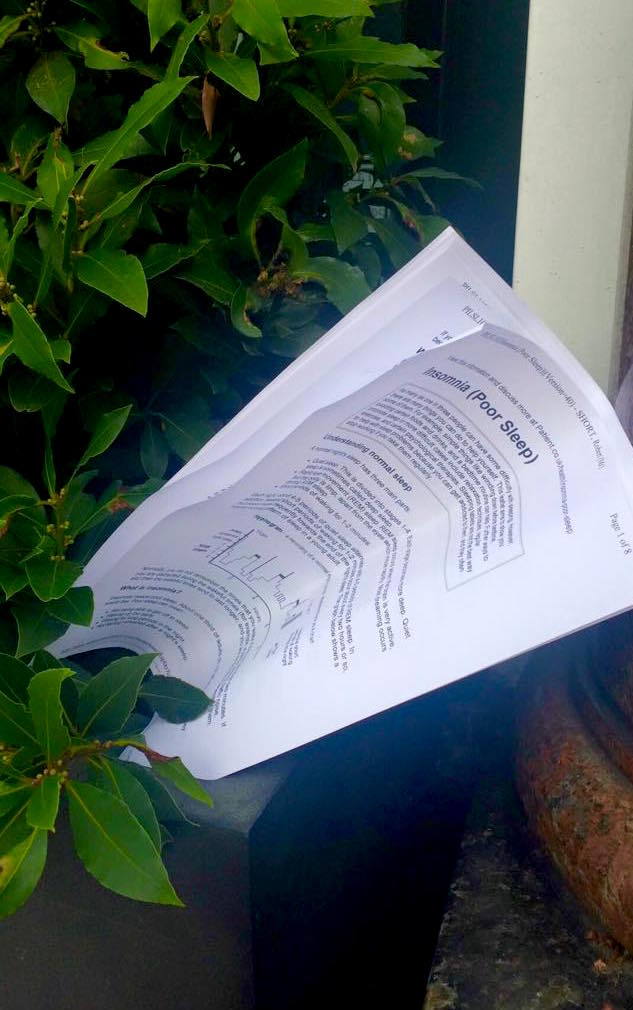
Oh, and the book I’m reading? The People in the Trees by Hanya Yanagihara.
[Originally posted as part of my life.actually adventures]
March 30, 2016
alone (adj., adv.)
alone (adj., adv.) from Old English all ana “unaccompanied, all by oneself”Apart from having a lot of time to myself in London surrounded by new friends, I’ve also spent some time by myself exploring other cities as well - cities like Vienna, Dublin, Berlin and Copenhagen. All these trips have involved visits with close friends, yet even so, I’ve still been quite aware of my unique, very personal, lone experience outside the shared experience, (which I of course cherish).
As I’ve gotten older and past my mid-twenties, I realized a noticeable shift towards relishing in experiencing things with myself. I value others no less; I think I just value myself more.
Even at times when my aloneness turns to loneliness, I remind myself I am not by myself. I remind myself I have a special moment - to be with myself. And these moments are truly sacred.
This is all quite opposite to how I once dealt with aloneness. I had fears of being alone for many years. And not necessarily fears of just being “alone" in life in general but of being “by myself” at any given time and space.
 |
| From an exhibit at the Tate Modern, "Performing for the Camera," exploring the ways in which we perform and manipulate who we are even in modes that appear to be realistic, voyeuristic, documentarian. |
A very extroverted person, I put in many efforts to be constantly with and around people. It was always easy for me, as I don’t get anxious around new people, groups, and I find it rather easy - and enjoyable - to “organize” other people into my life. I’ve also been very fortunate to have a really strong circle of people around me to draw from, in my eager mission to share my time with others, preferably loved ones.
Of course, I didn’t just pull others in to share in joyous experiences. At times of difficulty, indecision, restlessness or anxiety, I’d instinctively reach straight out to a friend or parent to grasp them for blind support, to pull them in so that I didn’t have to feel out the situation all on my own - and at certain times, to drag them right down with me because I didn’t have the clear judgment required to allow them to pull me up.
Oftentimes, it would all turn unnecessarily dramatic or would sap us both of energy because I couldn’t present a fair picture of what was wrong. And why? Because I hadn’t spent any time really assessing the picture more objectively for what it truly was. Many times the problem was me rather than the situation, or at least, it was much more simple than it seemed from the centre of my emotional storm. And how are we to ever have this clarity if we don’t take a moment to reflect?
For some people it’s harder to make room for time to be with themselves, especially at times of difficulty. I was one of those people. But in some ways, being forced to take things on (physically) alone, by moving out alone a few years ago, moving away alone more recently, and moving around as a traveler alone in spurts over many years, has taught me to appreciate being
No one can bring more insight to an experience you are living than you. By taking moments to listen to our inner thought processes, by spending time observing our given situations, we build more perspective on the situation and on ourselves in it. In a way, we make ourselves the object rather than the subject.
ye (pron.) Nominative plural of 2nd person pronoun þu (thou); Interestingly, the article ye was in fact an archaic way of writing the (þe), where the “y” character replaced the “thorn” (þ, representing the sound “th”), to accommodate printers at the time.I’ve learned to love to be with myself even when it’s tough. And I’ve learned to volunteer the time to be with myself and reflect, which has made me more attune to my feelings and where they’re really coming from. It enables me to find out what I can actually do about a difficult situation - if anything - before I engage someone else. And if I find that I can’t figure it out on my own, I know I am far more likely to be objective - and receptive - about another’s opinion when I do reach out.
National Express bus from Luton, March 28th, 9:55pm.
Originally posted on life.actually.tumblr.com.
October 3, 2015
step (v., n.)
Today, I signed my last rent cheque and just like that another milestone passed and I am one step closer to London.
Thinking about this on my way to work made me recall a chapter from DFW’s Infinite Jest. Near-death-turned-desperate long-time addict Don Gately learns that to arrive at a goal - like sobriety - only requires simple steps and training the mind to continue, to follow through. To take hold of something when you feel there's little to go on.
In the book, a fellow Ennet Recovery House resident offers Gately an analogy to help him deal with his doubt that prayer and AA-crafted internal dialogue will help him eventually drop the poison. The analogy? A Betty Crocker instant-cake mix. You follow the instructions and though you don’t really know the intricate details and chemistry of how the ingredients wind up turning into a cake in the end, you follow the instructions on the side of the box and can count on the fact that you’ll wind up with an edible cake as the end result.
You don’t necessarily have to have faith nor trust in that the steps will actually lead you to that ideal result, your dreamed-up destination or situation; all you have to do is start and follow the steps thoroughly, until one day you wake up sober, relaxed, and wondering how you ever doubted the process in the first place.
The last week has been a bit of a blur for me, as I’ve been mostly dealing with the logistics of moving - the paperwork. I handed in my resignation at work with a pretty heavy heart; I signed a sublet agreement with my friend Sam that marked a new chapter for the both of us; and yes, of course, I handed over that final October rent cheque.
I realize from the very start of all this back in August, when I made my decision to move away, it’s been mostly an act of going through the motions. Namely, getting through paperwork and rewiring my brain to spin this into an adventure rather than an ordeal; a continuation of a journey rather than a departure.
My heart hasn’t always been in every step, but I go through with each one anyway, one at a time, because I know if I proceed and tick the to-do boxes despite my emotional setbacks, I’ll eventually board that plane. I'll eventually wake up in London eating cake and feeling pretty okay about the whole thing....right?
Only one way to find out, I guess... Onto the next step...
+This cheesy over-used thing that you've probably been thinking about all along and which gets to the brunt of what I'm trying to articulate in far fewer steps...(ha!)
Thinking about this on my way to work made me recall a chapter from DFW’s Infinite Jest. Near-death-turned-desperate long-time addict Don Gately learns that to arrive at a goal - like sobriety - only requires simple steps and training the mind to continue, to follow through. To take hold of something when you feel there's little to go on.
step (v.) Old English steppan (Anglian), stæppan (West Saxon) "take a step," from West Germanic *stap- "tread', from PIE root *stebh- "post, stem; to support, place firmly on". The notion is perhaps "a treading firmly on; a foothold." Figurative meaning "action which leads toward a result" is recorded from 1540s.
In the book, a fellow Ennet Recovery House resident offers Gately an analogy to help him deal with his doubt that prayer and AA-crafted internal dialogue will help him eventually drop the poison. The analogy? A Betty Crocker instant-cake mix. You follow the instructions and though you don’t really know the intricate details and chemistry of how the ingredients wind up turning into a cake in the end, you follow the instructions on the side of the box and can count on the fact that you’ll wind up with an edible cake as the end result.
ingredient (n.) early 15c., from Latin ingredientem "that which enters into" (a compound, recipe, etc.), p.p. of ingredi "go in, enter," from in- + gradi "to step, go."
You don’t necessarily have to have faith nor trust in that the steps will actually lead you to that ideal result, your dreamed-up destination or situation; all you have to do is start and follow the steps thoroughly, until one day you wake up sober, relaxed, and wondering how you ever doubted the process in the first place.
The last week has been a bit of a blur for me, as I’ve been mostly dealing with the logistics of moving - the paperwork. I handed in my resignation at work with a pretty heavy heart; I signed a sublet agreement with my friend Sam that marked a new chapter for the both of us; and yes, of course, I handed over that final October rent cheque.
 |
| Paper: One of the many ingredients of life. |
I realize from the very start of all this back in August, when I made my decision to move away, it’s been mostly an act of going through the motions. Namely, getting through paperwork and rewiring my brain to spin this into an adventure rather than an ordeal; a continuation of a journey rather than a departure.
My heart hasn’t always been in every step, but I go through with each one anyway, one at a time, because I know if I proceed and tick the to-do boxes despite my emotional setbacks, I’ll eventually board that plane. I'll eventually wake up in London eating cake and feeling pretty okay about the whole thing....right?
Only one way to find out, I guess... Onto the next step...
+This cheesy over-used thing that you've probably been thinking about all along and which gets to the brunt of what I'm trying to articulate in far fewer steps...(ha!)
"A journey of a thousand miles begins with a single step."
- Lao Tzu
September 20, 2015
dream (v.)
I came across a piece of writing today and it articulated a feeling that for some time I couldn't quite find the words to describe - until now. It pinpoints the feeling I initially had when I ended a long-term relationship a couple of years ago:
Sometimes you mourn the fact that you never got to dream together at all. No specific plans for the future, no particular defined commitments, no hard realities that come from dealing with what's to come in that unknown future because you haven't given yourself/yourselves permission, and are riddled with the weight of a future in which you are alone, without them.
It's a strange thing being aware that as you grow with a person you're also nearing a specific end date; that with each gain and step closer towards them, you're simultaneously also getting closer to leaving them. (This is something I've known far too well ever since I booked my flight a couple of days ago).
Sometimes, there's an end date that forces you to be in the present much more than is usual; this is because the only future together you have is one where, well, you're not together, (so thinking about it makes it somewhat..oxymoronic, gut-wretchingly cataclysmic). Though all relationships are destined to end with the inevitability of passing time, this mindfulness and focus on the now is quite contrary to how many of us lead (or want to lead) romantic relationships: with delusional dreams of romantic "Forevers." Dreams that keep people together through the nightmares of life; ludicrous, irrational, but a tempting play to be a part of, nonetheless.
Or maybe, it's like experiencing a storm (this resonates right now given the windstorm that just hit BC). There's something very temporary running through but you also know that once it's passed, it will leave permanent marks. Stuff gets uprooted, truths fly more freely, the present experience envelops you, maybe makes you fly, too, (or just whirls you about and makes you fall...hard). But you get up and temper the storm by seeing it for its beauty; you enjoy the little lulls between the gusts so that you don't go reeling; you try to float for a bit unperturbed and remind yourself when reality hits that there's always something to be weathered, accepted, learned, and try to pull lessons from the hard realities.
When you're aware that things are finite, your appreciation grows, too. In the realm of relationships, you restrain your ego and its selfish proclivities; you stop risking miscommunications and wasted efforts that come from vain silences and ambiguous texts, the playing of games and the overthinking. You ask. You tell. You cut to the heart of things with less fear so as not to not waste time - because with all things acutely finite, time is of the essence.
It'd be great if we could apply this sense of urgency more readily in life, no? To wake to the fact that all our experiences are singular, unique, first and last, all finite, temporary, being weathered by time... all the time.
Undoubtedly, we'll all wake up and it'll be time to leave. For some things in life, the departure date is more certain; for others, it's just waiting far off in the hazy distance. Before then, (because it's always when not if,) rather than completely delude ourselves with dreams of distant uncertain futures and forevers, why not try and better acquaint ourselves with what is at our fingertips and appreciate the dream that's already happening here and now...?
I fear waking up of course out of fear that he won't be there. But what if he is and we can dream together, if not into distant dreamy futures, just one day.. one more moment at a time?
"One of the difficulties of leaving a relationship is not so much, at the end, leaving the person themselves — because, by that time, you’re ready to go; what’s difficult is leaving the dreams that you shared together. And you know that somehow — no matter who you meet in your life in the future, and no matter what species of happiness you would share with them — you will never, ever share those particular dreams again, with that particular tonality and coloration. And so there’s a lovely and powerful form of grief there that is the ultimate of giving away but making space for another form of reimagination." - David Whyte, "The Journey"And now, amidst a time when I am slowly preparing to leave Vancouver for a re-imagining of my own if you will - it's also helped me articulate a feeling I've been having more recently:
Sometimes you mourn the fact that you never got to dream together at all. No specific plans for the future, no particular defined commitments, no hard realities that come from dealing with what's to come in that unknown future because you haven't given yourself/yourselves permission, and are riddled with the weight of a future in which you are alone, without them.
It's a strange thing being aware that as you grow with a person you're also nearing a specific end date; that with each gain and step closer towards them, you're simultaneously also getting closer to leaving them. (This is something I've known far too well ever since I booked my flight a couple of days ago).
Sometimes, there's an end date that forces you to be in the present much more than is usual; this is because the only future together you have is one where, well, you're not together, (so thinking about it makes it somewhat..oxymoronic, gut-wretchingly cataclysmic). Though all relationships are destined to end with the inevitability of passing time, this mindfulness and focus on the now is quite contrary to how many of us lead (or want to lead) romantic relationships: with delusional dreams of romantic "Forevers." Dreams that keep people together through the nightmares of life; ludicrous, irrational, but a tempting play to be a part of, nonetheless.
dream (n.) Old Frisian dram, Dutch droom, German traum, perhaps from German cognate trügen "to delude," from de- "down" + ludere "to play" (see Latin ludicrus, "a game, play")It's an uncanny feeling this inevitable loss - however close or far in the future - but once you embrace it, it can also make things all the more wonderful. You actually liberate the relationship from the delusion of infinite time by being more concerned with what happens now. And the less time there is, the more tempting this becomes - mostly because it's the only way to operate and continue enjoying each other's company. You live in the moment and take all there is (and all there ever is is what's there right now). Some would call it denial or avoidance. But I say, it's closer to living in a dream.
Our revels now are ended. These our actors,
As I foretold you, were all spirits, and
Are melted into air, into thin air:
And like the baseless fabric of this vision,
The cloud-capp'd tow'rs, the gorgeous palaces,
The solemn temples, the great globe itself,
Yea, all which it inherit, shall dissolve,
And, like this insubstantial pageant faded,
Leave not a rack behind. We are such stuff
As dreams are made on; and our little life
Is rounded with a sleep.
- Shakespeare, The Tempest
Or maybe, it's like experiencing a storm (this resonates right now given the windstorm that just hit BC). There's something very temporary running through but you also know that once it's passed, it will leave permanent marks. Stuff gets uprooted, truths fly more freely, the present experience envelops you, maybe makes you fly, too, (or just whirls you about and makes you fall...hard). But you get up and temper the storm by seeing it for its beauty; you enjoy the little lulls between the gusts so that you don't go reeling; you try to float for a bit unperturbed and remind yourself when reality hits that there's always something to be weathered, accepted, learned, and try to pull lessons from the hard realities.
temper (n.) Old English temprian ‘bring something into the required condition by mixing it with something else,’ from Latin temperare ‘mingle, restrain oneself.’ Sense development was probably influenced by Old French temprer ‘to temper, moderate.’
When you're aware that things are finite, your appreciation grows, too. In the realm of relationships, you restrain your ego and its selfish proclivities; you stop risking miscommunications and wasted efforts that come from vain silences and ambiguous texts, the playing of games and the overthinking. You ask. You tell. You cut to the heart of things with less fear so as not to not waste time - because with all things acutely finite, time is of the essence.
It'd be great if we could apply this sense of urgency more readily in life, no? To wake to the fact that all our experiences are singular, unique, first and last, all finite, temporary, being weathered by time... all the time.
tempest (n.) from Old French tempeste, from Latin tempestas and tempus ‘season, weather, storm,' (see temporal, "temporary"). Sense evolution is from "period of time" to "period of weather," to "bad weather" to "storm." Words for "weather" originally were words for "time" in languages from Russia to Brittany.
Undoubtedly, we'll all wake up and it'll be time to leave. For some things in life, the departure date is more certain; for others, it's just waiting far off in the hazy distance. Before then, (because it's always when not if,) rather than completely delude ourselves with dreams of distant uncertain futures and forevers, why not try and better acquaint ourselves with what is at our fingertips and appreciate the dream that's already happening here and now...?
I fear waking up of course out of fear that he won't be there. But what if he is and we can dream together, if not into distant dreamy futures, just one day.. one more moment at a time?
September 6, 2015
stranded (adj.)
[The announcement's official - that I'm moving to the UK - so I can post this now. From September 6th]
This weekend, I learned that I've approached the "final" weeks of my time in Vancouver all wrong, or at least, in part.
I've had this idea that the next couple of months have to be filled with as much time with doing as many of my most favourite things with my most favourite people because time is ticking. I want to make as many new memories with them, in some valiant effort to solidify those relationships even more, give them more definition so that when I look back on them from miles and time zones away, they're less likely to look faded and distant. So that I don't feel stranded out there, in big ol' London, but instead, warmed by the embrace of those relationships and the moments that made them possible.
strand (v.) Figurative sense of "leave helpless," as of a ship left aground by the tide, is first recorded 1837. 1620s, "to drive aground on a shore," from noun strand.
- This year's long weekend, like all others since my decision to move, I planned on spending with those I care about most. It didn't go as planned though. Ironically, I got stranded, unable to find the evasive sign - and campsite - where my friends had set up shop for the weekend. I had no tent, and had driven for 4 hours (getting a wee bit lost having never been to Pemberton/Strawberry Point before).
- Stranded is being "left without the means to move from somewhere." Yet, ironically, being stranded this weekend has only given me more means to move away from Vancouver; it has given me more strength and confidence that it'll all work out.
 |
| Sometimes when we most think we have a chosen destination, we wind up places we never thought possible. |
- Yesterday, all signs were pointing down. I found myself driving on a very dodgy logging road, at KM 14 beyond the point where my friends had said we were camping. I knew they weren't there, as I had walked the shores looking for them and later found that I had cell service there - and knowing they didn't, meant they definitely weren't there. After some time at Strawberry Point, I got back in my car and decided to continue along the shoddy gravel pot-holed road, tires bumping hard and lifting dust behind me until I reached - and passed - the point where my cell lost service. Slowly rolling forward in my Corolla trying to avoid a flat tire, I stopped every car in sight to inquire, yelled "Ally or Andrew?" at every campsite along the shoreline, but...zilch. I eventually had to turn back, the sun sinking slowly and my faith dwindling along with it.
 |
| The smoothest patch of that logging road. |
- I made it back to Strawberry Point and the beautiful campsites there on the beach...and found an incredible group of people who had helped me out when I had first showed up on my search. Before I knew it, we were drinking around their massive bonfire, dancing to country music, talking and cooking up sausages at 4am, partying like old friends. By the next day, I was calling it "our campsite" and we were frying up potatoes in bacon fat on the grill together like we'd done it a billion summers before.
 |
| Who knew being stranded could look like this... |
 |
| Stranded? How about found. |
 |
| And just like that, even more ready for what tomorrow's tides will bring. |
- Eventually, and one day soon actually, I'll feel like
I'm sliding, lost in a new place wondering why I ever bothered to pluck
myself out of a wonderful place and relocate myself - and I'll
remember my drive home today, reminiscing on an unforgettable camping
adventure that showed me there's so much magic out there in the world to
be found, and that sometimes you have to trust the uncertain, move
toward the unfamiliar, and touch the edge of something to actually feel It.
strand (n.): Old English "shore, beach," from Proto-Germanic *strandaz (Old Norse cognate strönd "border, edge, shore.)
-~-
And as a final note, because, yes the universe works in mysterious ways...After I wrote this tonight, a good friend came over and I was telling him about how all my thinking of moving started around the time I came back from India last June. I mentioned, that perhaps, sometime, when I feel ready to venture back (or move elsewhere) after London, that I'd take myself back to India, visit the south this time, and round out the experience I had, a closure of sorts. Just as I was saying this, I felt the strands loosen from my wrist and I caught it, the worn and torn bracelet that I've had around my wrist since that temple visit in Varanasi...
 |
| A new chapter. My #IndiaThreads finally fall away after a very full and filling 14 months since a Hindu priest tied them around my wrist in Varanasi... |
July 18, 2015
flighty (adj.)
[En route to LHR, July 17, 4:15pm, Bulgaria time]
I'm feeling an immense feeling of...flightiness on this flight. (This is the tightest thought I've strung together since I boarded the plane in Sofia.) After much thinking, (often in daydreams while on transit) about my life in Vancouver, my family origins, and my travels, layered over and over in my brain - first in an orderly fashion, then spun out of control into a perplexed pirouette of folded thoughts resembling DNA chains - I feel entrapped in a tower of my history looking out into the skies of endless potential and vast opportunity. But it's a flimsy structure this tower, which quickly vanishes with the realization that I am uprooted regardless of where I am, leaning away and towards elsewhere, always.
Whether at home, kući, or in transit, I feel I'm always taking flight - because what is below is crumbling, whether because of unforecasted forecasts or because I danced and stomped too hard. Sometimes when I jump into these thoughts, I soar effortlessly in the smooth silken skies naked against the air that lifts me, pulled into the welcome embrace of some mystical vacuum made up of dreamy ambitions; other times, I ascend off a cliff, dragging upwards the whopping weight of my wings as I flail against the winds over me; usually I am with a flock but really, I fly solo regardless of conditions.
When I think of home in this very moment, my bookcases in Vancouver, like Tetris building blocks begin to crystallize in my mind, heavy and grounding, their titles defining who I am now in some way; but I also think of the two little hook holes I noticed in the tall Austrian doorway of our Marijin Dvor apartment when I recently visited with my dad, the chipped paint around them seemingly now the only surviving sign of my baby swing and my early childhood there. I could go on with my many visions of home, but I won't, because their sentimental nature tells me that really, I feel most at home in my heart: this place in which I perpetually seek - and find - shelter and comfort. And the same place which always draws me to check out yet again and board another plane and fly.
When I think of home in this very moment, my bookcases in Vancouver, like Tetris building blocks begin to crystallize in my mind, heavy and grounding, their titles defining who I am now in some way; but I also think of the two little hook holes I noticed in the tall Austrian doorway of our Marijin Dvor apartment when I recently visited with my dad, the chipped paint around them seemingly now the only surviving sign of my baby swing and my early childhood there. I could go on with my many visions of home, but I won't, because their sentimental nature tells me that really, I feel most at home in my heart: this place in which I perpetually seek - and find - shelter and comfort. And the same place which always draws me to check out yet again and board another plane and fly.
flight (n.) from Proto-Germanic *flug-ti-, from PIE*pluk-, from root *pleu- "to flow"; an "act of fleeing," c. 1200, flihht. To put (someone or something) to flight "rout, defeat" is from late 14c.
I, like many of my peers, sometimes ponder making a home somewhere new one day. As I sit here on this plane, I flightily fancy the notion that when I land, what if London were my final destination rather than the in-transit scrimmage line it has been every time thus far? I get this gruelling suspicion I would find nothing new here, albeit a new time zone where I can force a timeout and prove to myself that I can withstand the fluctuation in pressures, and adapt - but this is perhaps the only true remedy for this flighty, dreamy feeling. However unfamiliar a place, in due time, habit undoubtedly will form, setting it's own watery roots through me and into wherever I stand, settling me in.
Yes, eventually morning rituals and sleepless searches for entertainment take shape - regardless of culture or climate. A mirage made of familiarity appears like clusters of cloud, cushioning our seat in the world: a self-made ("homemade") delusion that yes, "I have arrived." And then I'm ready to fly again, lifted by the same cloud that shrouds my vision.
But all this is beautiful consolation, an answer to that deep-set sense of feeling astray and uncertain, a discovery and reminder that we are citizens of the world if we want to be - that I can be at home anywhere, no everywhere, so long as I feel confident in my ability to be open, to adapt.
But a soft landing requires practice.
Yes, eventually morning rituals and sleepless searches for entertainment take shape - regardless of culture or climate. A mirage made of familiarity appears like clusters of cloud, cushioning our seat in the world: a self-made ("homemade") delusion that yes, "I have arrived." And then I'm ready to fly again, lifted by the same cloud that shrouds my vision.
But all this is beautiful consolation, an answer to that deep-set sense of feeling astray and uncertain, a discovery and reminder that we are citizens of the world if we want to be - that I can be at home anywhere, no everywhere, so long as I feel confident in my ability to be open, to adapt.
But a soft landing requires practice.
The unknown and unseen beckons us to deport ourselves from what is near and to cut the strings, if only for a futile moment so that our imagination can take flight before the mortal anchor brings us down again. So take flight! Feel ephemeral, light, despite the weight of this world. Take your flights of fancy, however near or far...
flighty (adj.) 1550s, "swift," from flight (n.1) + -y (2). Sense of "fickle or frivolous" is from 1768, perhaps from notion of "given to 'flights' of imagination."
June 24, 2015
wake (n., v.) Reading David Foster Wallace's Infinite Jest
Excuse the lack of punctuation etc in this entry as I am curentlz typing ona tinz foreign keyboard, where the punctuation marks are hidden in super/subscript, require multi-digit ctr-alt-function-whatever motions and manz kezs have been swapped (mhm),semicolon,, I have little patience (at the cost of you, my limited audience, I know) - but if i were to stop and correct, i would do so at the expense of slowing down an insurgence of thoughts that come in the wake of my experience with a combination of things ill share with you below.
I had another lucid dream a few nights ago, likelz brought on bz jetlag, mz waking at 4am, reading Infinite Jest for an hour or two before falling into a buzzed numbing of sleep where i continue being awake. it was a failed attempt at a luciditz with full control, but i retained enough awareness of the fact that it was a dream to struggle in it and not be able to give in to the story unravelling, couldnt fall into the trance and rest my mind with body. instead, i lay awake watchful.
Waking from such dreams, where i have not reallz been entirelz ,asleep, is a strange feeling. I recall these dreams as real happenings, zet they bear no ,real, consequence on my life, albeit the emotions thez carrz on through to me in mz fullz wakeful state.its tiring being awake.
I had another lucid dream a few nights ago, likelz brought on bz jetlag, mz waking at 4am, reading Infinite Jest for an hour or two before falling into a buzzed numbing of sleep where i continue being awake. it was a failed attempt at a luciditz with full control, but i retained enough awareness of the fact that it was a dream to struggle in it and not be able to give in to the story unravelling, couldnt fall into the trance and rest my mind with body. instead, i lay awake watchful.
Waking from such dreams, where i have not reallz been entirelz ,asleep, is a strange feeling. I recall these dreams as real happenings, zet they bear no ,real, consequence on my life, albeit the emotions thez carrz on through to me in mz fullz wakeful state.
wake (v.) "to become awake," a Middle English merger of Old English wacan "to become awake, arise, be born, originate," and Old English wacian "to be or remain awake," (Gothic wakan "to watch", from root *weg- "to be strong, be lively" (cognates: Sanskrit vajayati "drives on;" Latin vigil "watchful, awake," vigere "be lively, thrive"), Middle Dutch wachten "to watch, guard;" Meaning "a sitting up at night with a corpse" is attested from early 15c.
- >Its tiring staying awake, too.
“The true opponent, the enfolding boundary, is the player himself. Always and only the self out there, on court, to be met, fought, brought to the table to hammer out terms. The competing boy on the net’s other side: he is not the foe: he is more the partner in the dance. He is the what is the word excuse or occasion for meeting the self. As you are his occasion. Tennis’s beauty’s infinite roots are self-competitive. You compete with your own limits to transcend the self in imagination and execution. Disappear inside the game: break through limits: transcend: improve: win. Which is why tennis is an essentially tragic enterprise, to improve and grow as a serious junior, with ambitions. You seek to vanquish and transcend the limited self whose limits make the game possible in the first place. It is tragic and sad and chaotic and lovely. All life is the same, as citizens of the human State: the animating limits are within, to be killed and mourned, over and over again.”
- David Foster Wallace, Infinite Jest
(or. the "endless war against the self you cannot live without.")
But we battle on I guess. the words of a dear friend, JS, brought me some consolation this morning.
The most i can do is yes, narrate it, leave words in my wake and let my enduring internal dialogue turn to script so that i can document my state as i live, wherever it is i find myself on the spectrum of sleep and wakefulness. thoughts gett lost but those that survive remind me that the onlz thing real to me is my voice, mz abilitz to attach expressions to these insurmountable ideas, anchor them in this space and in this time, and continue that effortless struggle to reason myself into motivation enough to continue, to change, grow, do, something as an alternative to a crippling confusion , tickling uncertainty, an infinite jest that without the dream would otherwise leave only room for a laughter, maddenning and unsatisfying in nature. and thats one thing i dare not relinquish: my sense of humour.In ten, twenty years or even next week we’ll look back on right now and think that what followed was inevitable. Don’t forget the uncertainty and unpredictability of today and how you are fighting for every decision, every accomplishment, and every outcome. We’re all surfing on the edge of an ever advancing reality and it’s easy to forget that even when life seems the same what comes next is always new and every minute forward must be earned, lived, and will ultimately be left in your wake for yourself and others to recall and narrate.
humour (n.) Middle English: via Old French from Latin humor ‘moisture’, from humere, humid. The original sense was ‘bodily fluid’ (surviving in aqueous humour and vitreous humour ); it was used specifically for any of the cardinal humours, wence ‘mental disposition’ was thought to be caused by their relative proportions, to determine state of mind. This led to a sense of "mood, temporary state of mind" (first recorded 1520s);p.s. im still not going to copzedit this entrz. it makes the madness - or humour - more convincing. You decide.
March 11, 2015
mindfull (adj.)
Today I experienced/ participated in my first guided "Shamata" meditation, at the Shambalah Tibetan Buddhist meditation centre (they hold free weekly classes). I say "experienced" and "participated" because of my reluctance to decide on how active or passive this "doing" was: I came away having felt the unequivocal tension and paradox present in the practice of meditation:
Arriving, then letting go; putting in effort, but not trying too hard; concentrating on not concentrating. Being gentle, but disciplined.
The gap between quietude in body and in mind eventually shrunk - as I tried to quiet the bustle of sentience and reason that seems to come naturally to us as we go about the world. On the cushion, the stillness of body gave way to my mind to start filling the space with a more calm, less visceral being.
I tagged this post with the label "travel" because I really went somewhere. Meditation ventured me somewhere between sleep and wakefulness on all fronts: For those 7 (?) minutes, I oscillated between a deep - yet subtle - feeling of just "being" (for infinitesimally short periods of time that somehow felt long enough for me to remember them) and a shallow, blunt protrusion of the most trivial thoughts, like "my eyes are watery" or "I am going to fall asleep" that brought me back to my physical existence.
What I gathered from the talk that followed, was that neither place - whether in shallow existing or in deep being - is "bad"; the aim of meditation is to become aware of both, and of everything in between; in time, you learn to hold more space for reflection on all experience, affording you a chance to mindfully respond to life rather than to impulsively react. The first step is to hold more space for ourselves, so that ultimately there is more space for one another; with enough practice, and as this becomes more normative, we can all play a part in contributing to a world of ubiquitous kindness, acceptance, compassion, tolerance - as opposed to aggression, rejection, and self-consciousness (the harmful kind).
One line from the teacher that struck me was
This reminded me that the foundation of all our forms or expressions - whether physical, spiritual, intellectual, or emotional, are the acts of the mind - how we come to reflect on our being in the world is what drives our responses and reactions, which has a huge impact (and may arguably be the sole influence) on how we come to form our identity and how we relate to others in the physical world.
Another line that resonated was the instruction to
To me, this simple notion of a thought just simply resting upon something, completely defines the act and aims of meditation. Just meditating on that spirals me closer toward that infinitesimal moment in time I experienced today and hope to tap into more often - of just being, and of being mindfull, not mindless.
*Disclaimer: I've long been curious in all sorts of philosophies, and spiritual practices (can you tell??), though I admit I've never taken to study any one kind or style at length nor in great detail; my authority to speak about meditation and mindfulness is solely based on my personal spiritual experience and my intermittent philosophical tinkering with a bit of informal everythings (or a whole lot of formalized nothing). So apologies if I've complicated, oversimplified, misnamed, misplaced, assumed, undermined or misused any terms, concepts, tenets, etc; I'm just rambling myself out of the absurdities and nausea of the existentialist's abyss following a relatively short stint into my subconscious. Thanks, and have a nice day!
Arriving, then letting go; putting in effort, but not trying too hard; concentrating on not concentrating. Being gentle, but disciplined.
The gap between quietude in body and in mind eventually shrunk - as I tried to quiet the bustle of sentience and reason that seems to come naturally to us as we go about the world. On the cushion, the stillness of body gave way to my mind to start filling the space with a more calm, less visceral being.
I tagged this post with the label "travel" because I really went somewhere. Meditation ventured me somewhere between sleep and wakefulness on all fronts: For those 7 (?) minutes, I oscillated between a deep - yet subtle - feeling of just "being" (for infinitesimally short periods of time that somehow felt long enough for me to remember them) and a shallow, blunt protrusion of the most trivial thoughts, like "my eyes are watery" or "I am going to fall asleep" that brought me back to my physical existence.
What I gathered from the talk that followed, was that neither place - whether in shallow existing or in deep being - is "bad"; the aim of meditation is to become aware of both, and of everything in between; in time, you learn to hold more space for reflection on all experience, affording you a chance to mindfully respond to life rather than to impulsively react. The first step is to hold more space for ourselves, so that ultimately there is more space for one another; with enough practice, and as this becomes more normative, we can all play a part in contributing to a world of ubiquitous kindness, acceptance, compassion, tolerance - as opposed to aggression, rejection, and self-consciousness (the harmful kind).
One line from the teacher that struck me was
see the body as a space to hold your mind.
This reminded me that the foundation of all our forms or expressions - whether physical, spiritual, intellectual, or emotional, are the acts of the mind - how we come to reflect on our being in the world is what drives our responses and reactions, which has a huge impact (and may arguably be the sole influence) on how we come to form our identity and how we relate to others in the physical world.
Another line that resonated was the instruction to
let your thoughts sit upon the breath, rather than to think through the breath.
To me, this simple notion of a thought just simply resting upon something, completely defines the act and aims of meditation. Just meditating on that spirals me closer toward that infinitesimal moment in time I experienced today and hope to tap into more often - of just being, and of being mindfull, not mindless.
 |
| “I cannot make you understand. I cannot make anyone understand what is happening inside me. I cannot even explain it to myself.” |
*Disclaimer: I've long been curious in all sorts of philosophies, and spiritual practices (can you tell??), though I admit I've never taken to study any one kind or style at length nor in great detail; my authority to speak about meditation and mindfulness is solely based on my personal spiritual experience and my intermittent philosophical tinkering with a bit of informal everythings (or a whole lot of formalized nothing). So apologies if I've complicated, oversimplified, misnamed, misplaced, assumed, undermined or misused any terms, concepts, tenets, etc; I'm just rambling myself out of the absurdities and nausea of the existentialist's abyss following a relatively short stint into my subconscious. Thanks, and have a nice day!
September 26, 2014
wear and tear (n., v.)
It seems like an eternity since I was in India - the daily routine has eaten away at the once recent and raw memories of that colourful place. I visited only relatively a short while ago: Three months exactly.
I feel it was a lifetime ago, though, in space and in time. The summer was busy ever since I got back, speckled with weekend trips, parties, hikes, picnics, long summer nights and generally long days, both in and out of the office. I crammed a lot into every day, and I've come out a bit exhausted - even more so than after my 37-hour journey home from Delhi, smelly, feverish, achy, and under-slept, with a full head and an overflowing heart.
This got me thinking about "wear and tear;" the consequences of time and space on both tangibles and the intangibles.
Having done a lot over the last few months makes the trip feel far away. Thinking back on my travels there, the experience feels increasingly foreign, almost as though it was an out-of-body experience; like I wasn't ever really there. All the other happenings in my life seem to have muddled the clarity of India that I once had and thought I'd hold on to forever.
 One thing that's served as a tool of remembrance, if you will, these past few months has been something quite banal, and increasingly ugly-looking (and definitely depreciated): A bunch of threads a Hindu priest tied around my wrist when he performed a puja for me in Varanasi. I didn't want to cut them away to avoid perverting their sacredness; another part of me kept it on because I wanted something I could see and touch - to act as proof that I had actually been there.
At times, when I'm driving my car through traffic I glance at my left-side mirror and catch a glimpse of the threads: I'm instantly reminded of the rickshaws that whirled me around Jaipur. Other times, as I shuffle around folders, staple briefs and printouts and curse "this damn paper cut!" I look down and I see the face of the woman who worked at the paper factory outside Jahnsi. And when I'm pissed at my pen running out of ink? That little hawker boy who sold me a dozen pens in Fatepur Sikri after he jumped on the back of our ride and redefined the word "perseverance."
Unlike the tenacious boy, however hard I try, this bracelet has no hope. It is slowly losing all its colour - having left red stains all over my bathrobe, and a number of left sleeves. Its threads get caught in zippers, earrings, and hairpins. In due time, it will fall off - I wonder if I'll even notice it.
Like these fading, thinning threads, my memories are also, fading, waning, tired.
I knew they would eventually wear away - both the bracelet and my memories. But, when the day comes and the bracelet does fall off my wrist, I won't let my memories go with it. Despite the business of the day-to-day, my "return" to the mundane motions of "regular" life, the memories will last. And without the crutch of this sentimentalized object on my hand.
It will be a tenacious effort on my part to hold on to those memories so they can breed mindful moments that move me so as I flutter and fluster through the everyday. I want lessons and insights and remarkable truths I discovered to inform me as I move forward, not remain as something in the past that loses value until it's forgotten, until it's nothing, worn and torn and thrown away.
So, I'll wear this bracelet proudly for now, but I won't get torn up about it when the time comes for it to come off. I'll take queues from the life I'm experiencing and apply what I have experienced so that my past doesn't depreciate. I'm holding on!
I feel it was a lifetime ago, though, in space and in time. The summer was busy ever since I got back, speckled with weekend trips, parties, hikes, picnics, long summer nights and generally long days, both in and out of the office. I crammed a lot into every day, and I've come out a bit exhausted - even more so than after my 37-hour journey home from Delhi, smelly, feverish, achy, and under-slept, with a full head and an overflowing heart.
This got me thinking about "wear and tear;" the consequences of time and space on both tangibles and the intangibles.
"Wear and tear is a form of depreciation which is assumed to occur even when an item is used competently and with care and proper maintenance."
Depreciation. What a horrid word.Having done a lot over the last few months makes the trip feel far away. Thinking back on my travels there, the experience feels increasingly foreign, almost as though it was an out-of-body experience; like I wasn't ever really there. All the other happenings in my life seem to have muddled the clarity of India that I once had and thought I'd hold on to forever.
At times, when I'm driving my car through traffic I glance at my left-side mirror and catch a glimpse of the threads: I'm instantly reminded of the rickshaws that whirled me around Jaipur. Other times, as I shuffle around folders, staple briefs and printouts and curse "this damn paper cut!" I look down and I see the face of the woman who worked at the paper factory outside Jahnsi. And when I'm pissed at my pen running out of ink? That little hawker boy who sold me a dozen pens in Fatepur Sikri after he jumped on the back of our ride and redefined the word "perseverance."
Unlike the tenacious boy, however hard I try, this bracelet has no hope. It is slowly losing all its colour - having left red stains all over my bathrobe, and a number of left sleeves. Its threads get caught in zippers, earrings, and hairpins. In due time, it will fall off - I wonder if I'll even notice it.
Like these fading, thinning threads, my memories are also, fading, waning, tired.
I knew they would eventually wear away - both the bracelet and my memories. But, when the day comes and the bracelet does fall off my wrist, I won't let my memories go with it. Despite the business of the day-to-day, my "return" to the mundane motions of "regular" life, the memories will last. And without the crutch of this sentimentalized object on my hand.
It will be a tenacious effort on my part to hold on to those memories so they can breed mindful moments that move me so as I flutter and fluster through the everyday. I want lessons and insights and remarkable truths I discovered to inform me as I move forward, not remain as something in the past that loses value until it's forgotten, until it's nothing, worn and torn and thrown away.
So, I'll wear this bracelet proudly for now, but I won't get torn up about it when the time comes for it to come off. I'll take queues from the life I'm experiencing and apply what I have experienced so that my past doesn't depreciate. I'm holding on!
July 23, 2014
eye contact (n.)
A bit of an odd phenomenon, this thing called eye contact. There's no actual contact (read: from Latin contactus "a touching, "to touch" con+tangere) involved - just a reciprocated seeing.
When there is no other form of physical contact with a person happening (be it for lack of language, words, or proximity,) no talking or touching or interacting, when the only form of contact is through the eyes, it produces a very unique effect. That deep-set feeling from staring back into another's pupils is really profound, dare I say, existential: They're seeing you just as you are seeing them. Kind of simple, but very... well, not simple at all.
Though I've always been aware of this special connection that happens when you lock eyes with another being, I really saw it in a whole other light when I was travelling in India.
Something about Indian people, which I hadn't experienced during any other travels before, was this incredible confidence that locals have: They look strangers straight in the eyes. I'm talking about an unrelenting, deep, serious staring. For extended periods of time. With no facial expression but one that says, "I see you."
It's the kind of eye contact that initially makes you uncomfortable. "They don't know me. Why are they looking at me?" It almost feels rude, like they're prying open your soul, seeing something that you don't show to the world, perhaps something you don't even know exists inside of you. So, in defense, you look away...and then, when you sneak a curious look back, you find that they're still looking at you. And they don't flinch; serious face still there, forging a tunnel into the depths of your being. You blink and cower.
A few times, I tried attaching to this drawn-out moment of eye contact some kind of additional nuanced response with my face - a nod, a smile, some type of more socially-normative form of expression to acknowledge this other person staring back at me. But rather than a polite Canadian reciprocation of a nod or a smile, most times, I received nothing in return but that same "I see you" stare - as though just offering my eyes should have been enough. And then I realized, it was.
After a while, I got used to it; I began to almost prefer it. The time it took to have that awkward feeling creep up on me became longer. A few days into my trip, I was testing myself, daring myself to confidently return the gaze, to respectfully reciprocate whatever length of eye contact was set by the other person. I undoubtedly always faltered first, moving my gaze away. But I tried.
After about a week or so into my trip, of travelling about, camera in hand, observing Indian everyday living, it stopped being a game I waited to be invited into. I started actually searching for faces to find that eye contact myself - so that I could be acknowledged - acknowledged as the stranger that I was.
Otherwise, my presence felt a ruse.
I didn't deserve to witness their lives because I knew as well as they did, that to me, these everyday activities were not so "everyday." I was enthralled by the activity around me: the washing of clothes, the building of chairs, the sweeping of storefronts, of shaving beards and frying up dough. I started to feel guilty watching these (their) moments unfold in front of me, without some form of acknowledgement from them of my being there, an unspoken consent if you will, that here I was, observing and undoubtedly judging with a stranger's eyes. It felt odd watching, let alone pointing my camera lens. But I only started to feel this way after the first few times I was laid bare, exposed....by eye contact. I had been caught and there was no going back - unless to look back.
See, the thing with eye contact is that it pinpoints you as one who is witnessed, not solely as one who is witnessing. When you're travelling, it's easy to think it's all there for your taking, that it's all there to entertain you, with scenes unravelling in front of your eyes for your particular enjoyment because you came all this way to see this. But really, you're the outsider, the one entering a world that is always happening whether you're there to witness it or not. When someone catches you doing that, stares you down (whether intentionally or not), you realize this truth, and you never want to go back to being that ignorant one-way observer.
You need to expose yourself if you are really to see anything. Establish connection with the place by establishing eye contact with its people. You'll find that you'll not only see something different, you'll also see those things differently. They'll be more real to you, because you will have been more real to them.
When there is no other form of physical contact with a person happening (be it for lack of language, words, or proximity,) no talking or touching or interacting, when the only form of contact is through the eyes, it produces a very unique effect. That deep-set feeling from staring back into another's pupils is really profound, dare I say, existential: They're seeing you just as you are seeing them. Kind of simple, but very... well, not simple at all.
Though I've always been aware of this special connection that happens when you lock eyes with another being, I really saw it in a whole other light when I was travelling in India.
Something about Indian people, which I hadn't experienced during any other travels before, was this incredible confidence that locals have: They look strangers straight in the eyes. I'm talking about an unrelenting, deep, serious staring. For extended periods of time. With no facial expression but one that says, "I see you."
It's the kind of eye contact that initially makes you uncomfortable. "They don't know me. Why are they looking at me?" It almost feels rude, like they're prying open your soul, seeing something that you don't show to the world, perhaps something you don't even know exists inside of you. So, in defense, you look away...and then, when you sneak a curious look back, you find that they're still looking at you. And they don't flinch; serious face still there, forging a tunnel into the depths of your being. You blink and cower.
A few times, I tried attaching to this drawn-out moment of eye contact some kind of additional nuanced response with my face - a nod, a smile, some type of more socially-normative form of expression to acknowledge this other person staring back at me. But rather than a polite Canadian reciprocation of a nod or a smile, most times, I received nothing in return but that same "I see you" stare - as though just offering my eyes should have been enough. And then I realized, it was.
After a while, I got used to it; I began to almost prefer it. The time it took to have that awkward feeling creep up on me became longer. A few days into my trip, I was testing myself, daring myself to confidently return the gaze, to respectfully reciprocate whatever length of eye contact was set by the other person. I undoubtedly always faltered first, moving my gaze away. But I tried.
After about a week or so into my trip, of travelling about, camera in hand, observing Indian everyday living, it stopped being a game I waited to be invited into. I started actually searching for faces to find that eye contact myself - so that I could be acknowledged - acknowledged as the stranger that I was.
Otherwise, my presence felt a ruse.
I didn't deserve to witness their lives because I knew as well as they did, that to me, these everyday activities were not so "everyday." I was enthralled by the activity around me: the washing of clothes, the building of chairs, the sweeping of storefronts, of shaving beards and frying up dough. I started to feel guilty watching these (their) moments unfold in front of me, without some form of acknowledgement from them of my being there, an unspoken consent if you will, that here I was, observing and undoubtedly judging with a stranger's eyes. It felt odd watching, let alone pointing my camera lens. But I only started to feel this way after the first few times I was laid bare, exposed....by eye contact. I had been caught and there was no going back - unless to look back.
See, the thing with eye contact is that it pinpoints you as one who is witnessed, not solely as one who is witnessing. When you're travelling, it's easy to think it's all there for your taking, that it's all there to entertain you, with scenes unravelling in front of your eyes for your particular enjoyment because you came all this way to see this. But really, you're the outsider, the one entering a world that is always happening whether you're there to witness it or not. When someone catches you doing that, stares you down (whether intentionally or not), you realize this truth, and you never want to go back to being that ignorant one-way observer.
You need to expose yourself if you are really to see anything. Establish connection with the place by establishing eye contact with its people. You'll find that you'll not only see something different, you'll also see those things differently. They'll be more real to you, because you will have been more real to them.
July 20, 2014
travel (n., v.)
I know it to be foolish to attempt to share my recent travel experience in a blog post. Even speaking to my friends about some of what I encountered in India has been difficult, as words don't do the experience justice, merely scraping the surface of something very...thick. Photos fail as complete aids too, as they only capture a single layer of a stupefyingly complex sensory experience.
I've travelled many a place in my short life (I counted 5 countries within the last year alone) but this was the first time that I got a glimpse of travel as "travail" - a difficult journey.
Originally, any form of "travel" (in the Middle Ages, whence the word originated) was found to be difficult, labourious, hence the etymology. But over the centuries, travel as we have come to know it has become easier - less about necessity and transportation and more about choice and place. We travel to find respite from the everyday, in an aim to encounter something new. It's beyond the experience of the journey of getting to a place and more about being at the destination itself.
It's about what starts upon arrival.
For the first time in my life, this wasn't entirely the case for me. My departure for India started weeks before I found myself in any close proximity to an airplane. And my arrival and experience while there has extended far beyond the time when I returned to Canadian soil.
I went into it with a head full of facts, of "don't do's" and "avoid that's," of cautionary tales and reminders - all realistic and justified but also barriers to a full experience. So, as with any travel (or at least the kind I prefer and gravitate to), I committed to going in with an open heart. I wrapped my head around expectations and assumptions, and then tried to let go.
I tried to train myself to be aware, tough, and cautious while also trusting, warm, and conscientious so that I could hit the streets, enter dark places, speak to people and be a participant and not a mere observer. I wanted to build my understanding of India from scratch, which is why it's been difficult to convey fully.
Following heart rather than head discouraged me from yielding to fear, so that I could feed my curiosities and connect with the place and actually feel it. Years of traveling and generally aiming to be open to new experiences in everyday life, has helped me hone not just my inner voice but my inner ear as well. I truly got to test that intuition and approach in India. And it was hard work.
I let my heart lead, and supported by my stomach, that gut feeling, I became more confident in listening to my intuition and not just my reason, which was often guided by cultural shock and fear and awkwardness.
Daily, my senses were inundated with a myriad of impossible happenings occurring all in a relatively small, but very real, space.
(I have a distinct memory of a colourfully clad woman with a sack of something that looked pretty heavy on her head, holding two babies in one arm, her other hand busied with manouvering her sari to cover her mouth as she stepped into a cloud of vapour and mist. My eyes followed her steps as she merged into an intersection where she was met by a speeding rickshaw that missed her hip by a few inches, a surprisingly fast-moving cement roller with an elderly half-naked turbaned man crouching at its wheel, his knees jutted out by his ears, and below her at her bare feet, a deformed young man struggling to move himself forward on a small wooden cart. She squeezed by a black, bony cow obliviously dawdling next to her, miraculously avoiding the dung and burning garbage (read: open flames) on the unpaved ground. Accompany this short four-second frame with a cacophony of honks, horns, bells, and incomprehensible human and animal voices, and a heavy humidity in the air that carries dozens of odours and fragrances that stick to your skin and sting your eyes, and you'll still have a vague understanding.)
In the regions I visited of Rajasthan and Uttar Pradesh, and particularly in the city markets (Kinari in Agra, for example, from which I drew the above sequence) it was hard not to gape in awe, with eyes, tongue, ears, nostrils, fingers, all ready to take in the scene in all its various forms. But I had to consciously remind myself to open my heart.
Amidst the hodgepodge of machinery and limbs, noise, colours and smells and mire, I searched for opportunity when most everything seemed to teem with risk (whether serious danger or the potential of contracting the dreaded "delhi belly"). With effort, the initial miasma of Indian life, of that traffic, poverty, and filth (garbage in all four states) transformed into a kind of magical show, though: A medley of unlikely occurrences and dense bits of experience that came together making me believe there was no single other possible way this place could be. In the villages and smaller towns, this remained to be true; it just came in smaller, though equally concentrated, doses.
It was hard work, remaining cautious without being paranoid; my eyes darted about seeking eye contact without the lens of a viewfinder. I aggressively bartered through offers (a true Yugo, I am!), but modestly accepted puja offerings (pretended to taste and swallow the sweet sticky mess). I wove conversations but knew when to untangle myself and respectfully bid goodbye; I removed my shoes along with my prejudices; and thanks to my heart, I discovered similarities in a place that could not have been more unfamiliar or uncomfortable to me.
A land of contrasts. I salivated between wafts of indescribably disgusting odours, laughed heartily with people amidst an unbearable presence of stark hardships, shuddered at fifty degrees, and sometimes, just didn't know what to feel except present.
India, despite its initial hard exterior, was an incredibly inviting, pleasant, even at times, relaxing, place. In the presence of a lot of misery, I found a lot of joy, celebration, and kindness - the kind you find everywhere where there is human life. Even the notoriously aggressive touts when approached the right way, with respect, backbone and warmth, reciprocated, dropping their greedy guise to offer a smile and a joke.
It wasn't easy to arrive at this kind of India; it took a certain effort and altering of attitude to step up, open up, and enter. But I expected this, and prepared myself for it. What I didn't foresee was the difficulty that I'd experience in not just getting there or being there, but in coming home.
I'm still in a bit of a dream-like state since I returned. Looking around me, I'm peering through haze, but a different kind now. It's not one seen as easily as the one that so persistently hovered in the Indian air (the weather app for Delhi usually read "haze" and on one occasion even "smoke").
I'd like to think I'm thinking clearly, especially given the space I now have to reflect on my travels - this clean, quiet Vancouver of squeaky glass, even pavement and picturesque scenery and greenery. Returning to an orderly life, where everything is so void of..distractions..with nothing vying for my attention but the dreaded iPhone notifications I succumb to is more difficult than I thought.
Staying put, a travail of its own...
I've travelled many a place in my short life (I counted 5 countries within the last year alone) but this was the first time that I got a glimpse of travel as "travail" - a difficult journey.
Originally, any form of "travel" (in the Middle Ages, whence the word originated) was found to be difficult, labourious, hence the etymology. But over the centuries, travel as we have come to know it has become easier - less about necessity and transportation and more about choice and place. We travel to find respite from the everyday, in an aim to encounter something new. It's beyond the experience of the journey of getting to a place and more about being at the destination itself.
It's about what starts upon arrival.
For the first time in my life, this wasn't entirely the case for me. My departure for India started weeks before I found myself in any close proximity to an airplane. And my arrival and experience while there has extended far beyond the time when I returned to Canadian soil.
I went into it with a head full of facts, of "don't do's" and "avoid that's," of cautionary tales and reminders - all realistic and justified but also barriers to a full experience. So, as with any travel (or at least the kind I prefer and gravitate to), I committed to going in with an open heart. I wrapped my head around expectations and assumptions, and then tried to let go.
I tried to train myself to be aware, tough, and cautious while also trusting, warm, and conscientious so that I could hit the streets, enter dark places, speak to people and be a participant and not a mere observer. I wanted to build my understanding of India from scratch, which is why it's been difficult to convey fully.
Following heart rather than head discouraged me from yielding to fear, so that I could feed my curiosities and connect with the place and actually feel it. Years of traveling and generally aiming to be open to new experiences in everyday life, has helped me hone not just my inner voice but my inner ear as well. I truly got to test that intuition and approach in India. And it was hard work.
I let my heart lead, and supported by my stomach, that gut feeling, I became more confident in listening to my intuition and not just my reason, which was often guided by cultural shock and fear and awkwardness.
Daily, my senses were inundated with a myriad of impossible happenings occurring all in a relatively small, but very real, space.
(I have a distinct memory of a colourfully clad woman with a sack of something that looked pretty heavy on her head, holding two babies in one arm, her other hand busied with manouvering her sari to cover her mouth as she stepped into a cloud of vapour and mist. My eyes followed her steps as she merged into an intersection where she was met by a speeding rickshaw that missed her hip by a few inches, a surprisingly fast-moving cement roller with an elderly half-naked turbaned man crouching at its wheel, his knees jutted out by his ears, and below her at her bare feet, a deformed young man struggling to move himself forward on a small wooden cart. She squeezed by a black, bony cow obliviously dawdling next to her, miraculously avoiding the dung and burning garbage (read: open flames) on the unpaved ground. Accompany this short four-second frame with a cacophony of honks, horns, bells, and incomprehensible human and animal voices, and a heavy humidity in the air that carries dozens of odours and fragrances that stick to your skin and sting your eyes, and you'll still have a vague understanding.)
In the regions I visited of Rajasthan and Uttar Pradesh, and particularly in the city markets (Kinari in Agra, for example, from which I drew the above sequence) it was hard not to gape in awe, with eyes, tongue, ears, nostrils, fingers, all ready to take in the scene in all its various forms. But I had to consciously remind myself to open my heart.
Amidst the hodgepodge of machinery and limbs, noise, colours and smells and mire, I searched for opportunity when most everything seemed to teem with risk (whether serious danger or the potential of contracting the dreaded "delhi belly"). With effort, the initial miasma of Indian life, of that traffic, poverty, and filth (garbage in all four states) transformed into a kind of magical show, though: A medley of unlikely occurrences and dense bits of experience that came together making me believe there was no single other possible way this place could be. In the villages and smaller towns, this remained to be true; it just came in smaller, though equally concentrated, doses.
It was hard work, remaining cautious without being paranoid; my eyes darted about seeking eye contact without the lens of a viewfinder. I aggressively bartered through offers (a true Yugo, I am!), but modestly accepted puja offerings (pretended to taste and swallow the sweet sticky mess). I wove conversations but knew when to untangle myself and respectfully bid goodbye; I removed my shoes along with my prejudices; and thanks to my heart, I discovered similarities in a place that could not have been more unfamiliar or uncomfortable to me.
A land of contrasts. I salivated between wafts of indescribably disgusting odours, laughed heartily with people amidst an unbearable presence of stark hardships, shuddered at fifty degrees, and sometimes, just didn't know what to feel except present.
India, despite its initial hard exterior, was an incredibly inviting, pleasant, even at times, relaxing, place. In the presence of a lot of misery, I found a lot of joy, celebration, and kindness - the kind you find everywhere where there is human life. Even the notoriously aggressive touts when approached the right way, with respect, backbone and warmth, reciprocated, dropping their greedy guise to offer a smile and a joke.
It wasn't easy to arrive at this kind of India; it took a certain effort and altering of attitude to step up, open up, and enter. But I expected this, and prepared myself for it. What I didn't foresee was the difficulty that I'd experience in not just getting there or being there, but in coming home.
I'm still in a bit of a dream-like state since I returned. Looking around me, I'm peering through haze, but a different kind now. It's not one seen as easily as the one that so persistently hovered in the Indian air (the weather app for Delhi usually read "haze" and on one occasion even "smoke").
I'd like to think I'm thinking clearly, especially given the space I now have to reflect on my travels - this clean, quiet Vancouver of squeaky glass, even pavement and picturesque scenery and greenery. Returning to an orderly life, where everything is so void of..distractions..with nothing vying for my attention but the dreaded iPhone notifications I succumb to is more difficult than I thought.
Staying put, a travail of its own...
 |
| More pics from my trip here... |
July 8, 2013
ferry (n.)
While long overdue, this story must be told. Why? To remind everyone to have a little faith in each other, in magical happenings, in the spontaneous, the whimsical, the serendipitous.
The summer is upon us, dear Raincouver. Looking outside, it's hard to believe we were donning raincoats and rubber boots a few weeks ago, thinking about whether to bother putting away our winter clothes this year. It really looked like we were having yet another Junuary, and one quite possibly to be followed by a Julember, too.
But, lo and behold, the weather fairy is on our side. The sun came out for us this month, and for the last few weeks it hasn't been shy, to say the least. It's prying us out of our office chairs at lunch and bronzening our shoulders as we commute to and fro. But when the weekend nears, there's a city-wide frenzy: How to pack in as much outside as possible into our days off? Where can we enjoy this sunshine the most?
Many head straight to the beach, others head to a nearby patio to soak in the rays over a cool brewskie. Others yet, seek adventure outside the city, in a search for greenery, farmers markets, and activities not yet familiar.... For me, this year's solstice meant grabbing my best friend, eeney-meeny-miney-moe-ing our finger at the map of the Gulf Islands, and letting the travel fairy tell us where we were going for the day.
 Saltspring won. Neither of us had ever been there (I can't believe this could be the case for any long-term Vancouverite, now that I've been). By noon, we were ready to disembark from Tsawassen, casually sipping on our Americanos, buzzed for the day ahead. We parked our car near the ferry terminal at $11/day (Note to travellers: This is a really great alternative to ferry lineups and expensive fees to take the car over, especially when traveling to places where you really don't need wheels, like Victoria). After a quick (free) shuttle form the parking lot, we were boarding the ship.
After about 90 minutes, we arrived on the shores of lovely Saltspring Island, a little perplexed about how we'd get around from that point forward. Thankfully, the commuter fairy was looking after us, and a little shuttle appeared at Long Harbour ready to take us over to Ganges, the little big town on the island.
 After arriving in Ganges, we did the rounds and a cute restaurant caught our eye: The Tree House Cafe. We were instantly struck by the all-encompassing tree at the restaurant's centre. It seemed the cafe was growing right out of it, each little table a bud, the kitchen its anchoring roots holding the whole thing together. We instantly made our way to the front and were seated within minutes. Yam enchiladas and green curries arrived - and disappeared soon after.
Everything seemed magical about this place - like we were taken around by waves of chance, going from one point to the next. After lunch, we were told by our server that we must make our way to the renowned Saturday Market, where local artisans and bakers offered up their best. Amongst these, soap gifts were bought, as were incredibly beautiful silver pearl dangling earrings, which are hanging off my earlobes as I write this.

 We were in the flow, talking to locals, asking for directions and advice. We eventually were drawn to the Mistaken Identity Winery. On the way, we turned a corner in the wrong direction - correction: a new direction (on this magical day, there was no such thing as “wrong”). Just ahead of us, a lovely bookstore appeared, perfectly placed in our line of vision.
Some hilarious titles in the “free bin” fortunately caught my attention. Had I not looked down, I wouldn't have noticed the words "Griffin and Sabine" plastered on the window - which ultimately led us to step inside. The bookstore's walls were covered by the original artwork by one of my favourite artists, Nick Bantock, who we later found out had lived on the island some years. Up the stairs, we found a quaint little blue room, dedicated to the author, with bookshelves filled with signed copies of many of his most famous works. I was in awe. The work of another fairy?
 After some walking up the road to the winery in our new rubber sparkly shoes (we happened upon them in a nearby gift shop - a fairytale indeed!), we took in some relaxation between sips of wine. When we “tired” of lounging around amidst the vines, we decided to head back to the town for dinner. We indulged in some seafood accompanied by more wine in the sunshine before getting ready to catch our ferry back home at 8:45pm - the perfect denouement to our tale. Little did we know we were just hitting the peak of the arc.
After another stop at the Tree House Cafe - for Chai lattes and a phone to call up the cab (our cells had little-to-no reception) - we were on our way back to Long Harbour.
We arrived early to an empty marina. We walked down to a beach a little ways away to wait for the ferry, and once the clock struck 8:40pm, we emerged up the hill to find - an empty marina. After some strained iPhone research (due to fading bars) - we learned that the summer schedule was upon us. The next ferry wasn't leaving until 7:15 the next morning. Uh oh.
The sun setting fast behind us and the long road to Ganges ahead of us, left us in a bit of a lurch. We were in high spirits still, trying to think positive, though the 7 km road to 'civilization' taunted us. We knew deep inside that once the night set in, if we were still walking down that road, freezing our bums off cut off from the world, it'd be hard holding those smiles. An #SOS tweet and a few fuzzy phone calls later - for lodgings, advice, phone numbers, anything - yielded little. The last text that made it through to my boyfriend was something along the lines of "We're just walking on an empty road..." And Google Maps? Facebook? Ha - As if.
But just like a fairy tale, the danger would subside and we, the damsels in distress, would find our chariot. Only one car had passed us since we had started walking. So, when we saw another, we flailed our arms, clutching maps and dying iPhones in one last attempt to reach for human contact.
The car stopped. From the Mazda emerged a girl, about our age: Our saviour - with a working phone in hand (Rogers customers, don't take your cell phones to Saltspring... try Telus instead!) Yet, instead of offering to let us use her phone, she offered to spot us for the night. We were exhilarated. Jumping into her car, we just couldn't believe it. An adventure turned epic. We later learned that she had apparently seen us at the Tree House Cafe (she manages the restaurant!) and so we looked familiar.
To make this long story short, we all lived happily ever after. Our lovely new friend, Emily, and her boyfriend, Pat, served up some drinks and we talked through the night, laughing, reminiscing, sharing stories of travels and life. The night finally drew to a close outside on their lawn, with us looking up at a rare yellow moon through a telescope. Our heads hit the pillow around 2:30 am and four short hours later, the alarm rang, and half in daydream, off we were in the car again, accepting a ride from our new friends back to the ferry terminal, the catalytic setting of this great tale.
Watching the world through a mystical lens really allowed great things to happen and to keep on happening, I think. And we truly did have the fairies on our side - even when the ferry schedule wasn't. In retrospect, given our luck, we really got lucky. So thank you, world, and people and fairies of all places for restoring our faith in the magical, the unknown.
The summer is upon us, dear Raincouver. Looking outside, it's hard to believe we were donning raincoats and rubber boots a few weeks ago, thinking about whether to bother putting away our winter clothes this year. It really looked like we were having yet another Junuary, and one quite possibly to be followed by a Julember, too.
But, lo and behold, the weather fairy is on our side. The sun came out for us this month, and for the last few weeks it hasn't been shy, to say the least. It's prying us out of our office chairs at lunch and bronzening our shoulders as we commute to and fro. But when the weekend nears, there's a city-wide frenzy: How to pack in as much outside as possible into our days off? Where can we enjoy this sunshine the most?
Many head straight to the beach, others head to a nearby patio to soak in the rays over a cool brewskie. Others yet, seek adventure outside the city, in a search for greenery, farmers markets, and activities not yet familiar.... For me, this year's solstice meant grabbing my best friend, eeney-meeny-miney-moe-ing our finger at the map of the Gulf Islands, and letting the travel fairy tell us where we were going for the day.

After about 90 minutes, we arrived on the shores of lovely Saltspring Island, a little perplexed about how we'd get around from that point forward. Thankfully, the commuter fairy was looking after us, and a little shuttle appeared at Long Harbour ready to take us over to Ganges, the little big town on the island.

Everything seemed magical about this place - like we were taken around by waves of chance, going from one point to the next. After lunch, we were told by our server that we must make our way to the renowned Saturday Market, where local artisans and bakers offered up their best. Amongst these, soap gifts were bought, as were incredibly beautiful silver pearl dangling earrings, which are hanging off my earlobes as I write this.

 We were in the flow, talking to locals, asking for directions and advice. We eventually were drawn to the Mistaken Identity Winery. On the way, we turned a corner in the wrong direction - correction: a new direction (on this magical day, there was no such thing as “wrong”). Just ahead of us, a lovely bookstore appeared, perfectly placed in our line of vision.
 Some hilarious titles in the “free bin” fortunately caught my attention. Had I not looked down, I wouldn't have noticed the words "Griffin and Sabine" plastered on the window - which ultimately led us to step inside. The bookstore's walls were covered by the original artwork by one of my favourite artists, Nick Bantock, who we later found out had lived on the island some years. Up the stairs, we found a quaint little blue room, dedicated to the author, with bookshelves filled with signed copies of many of his most famous works. I was in awe. The work of another fairy?
 After some walking up the road to the winery in our new rubber sparkly shoes (we happened upon them in a nearby gift shop - a fairytale indeed!), we took in some relaxation between sips of wine. When we “tired” of lounging around amidst the vines, we decided to head back to the town for dinner. We indulged in some seafood accompanied by more wine in the sunshine before getting ready to catch our ferry back home at 8:45pm - the perfect denouement to our tale. Little did we know we were just hitting the peak of the arc.
 After another stop at the Tree House Cafe - for Chai lattes and a phone to call up the cab (our cells had little-to-no reception) - we were on our way back to Long Harbour.
We arrived early to an empty marina. We walked down to a beach a little ways away to wait for the ferry, and once the clock struck 8:40pm, we emerged up the hill to find - an empty marina. After some strained iPhone research (due to fading bars) - we learned that the summer schedule was upon us. The next ferry wasn't leaving until 7:15 the next morning. Uh oh.
The sun setting fast behind us and the long road to Ganges ahead of us, left us in a bit of a lurch. We were in high spirits still, trying to think positive, though the 7 km road to 'civilization' taunted us. We knew deep inside that once the night set in, if we were still walking down that road, freezing our bums off cut off from the world, it'd be hard holding those smiles. An #SOS tweet and a few fuzzy phone calls later - for lodgings, advice, phone numbers, anything - yielded little. The last text that made it through to my boyfriend was something along the lines of "We're just walking on an empty road..." And Google Maps? Facebook? Ha - As if.
But just like a fairy tale, the danger would subside and we, the damsels in distress, would find our chariot. Only one car had passed us since we had started walking. So, when we saw another, we flailed our arms, clutching maps and dying iPhones in one last attempt to reach for human contact.
The car stopped. From the Mazda emerged a girl, about our age: Our saviour - with a working phone in hand (Rogers customers, don't take your cell phones to Saltspring... try Telus instead!) Yet, instead of offering to let us use her phone, she offered to spot us for the night. We were exhilarated. Jumping into her car, we just couldn't believe it. An adventure turned epic. We later learned that she had apparently seen us at the Tree House Cafe (she manages the restaurant!) and so we looked familiar.
To make this long story short, we all lived happily ever after. Our lovely new friend, Emily, and her boyfriend, Pat, served up some drinks and we talked through the night, laughing, reminiscing, sharing stories of travels and life. The night finally drew to a close outside on their lawn, with us looking up at a rare yellow moon through a telescope. Our heads hit the pillow around 2:30 am and four short hours later, the alarm rang, and half in daydream, off we were in the car again, accepting a ride from our new friends back to the ferry terminal, the catalytic setting of this great tale.
Watching the world through a mystical lens really allowed great things to happen and to keep on happening, I think. And we truly did have the fairies on our side - even when the ferry schedule wasn't. In retrospect, given our luck, we really got lucky. So thank you, world, and people and fairies of all places for restoring our faith in the magical, the unknown.
April 7, 2012
deadline (n.)
Today, as I take a brief break from formatting my MPub thesis, I bring to you an entry that is mostly dedicated to myself. (Sorry.)
I've been pushing and pushing to get this thing done by April 16th, the day for which I've booked an appointment with the Assistant to Theses at SFU to submit my project report finally. I've been battling the red tape, though, and have spent hours interpreting the convoluted requirements for what consists of a complete thesis package. How do I know if it's "applicable"? Is "suggested" stronger than "optional"? I've fixed style errors, typos, and made it look almost nice. I've sifted through words like a proofreading robot, vowing to never read again.

I've also persisted against the Approvals Page margin problem (thank you fast-ass Purolator and wonderful Zahra at RDC!) and will hopefully have the entire committee's signatures by the end of next week. Now I'm inserting figures into the body of my report (with fingers crossed that I can use them all, as I wait to hear a few answers regarding a couple permissions requests). Once that's done, I'll start getting all the documentation in order, ticking off the list (and checking it twice). Then, off to the printer I go to figure out what "20lb bond paper acid free laser" paper is (maybe I already know) so that I can print it all, stick it in cream-coloured folders with perfect labels on them and submit it at the thesis office.
I've been picturing this scenario over and over again in my head, except that I'm clutching my folders as I run across a finish line. It's a bit less scary than thinking of it as a deadline.
What SFU claims to be "3 steps to submission" really feels more like a marathon - but I'm okay with that. At least I know I'm moving forward, rather than having that dreaded deadline looming over me, as though it's getting closer to me, instead of me chasing it.
So here's to killing the deadline (ironic pun intended) and advocating for the finish line!
Because, if I hit that finish line on April 16th, I am going to be a very happy camper.
Literally.
(Yup, I've decided -come hell or high water- I'm going to Coachella!!)
Of course, I also have a back-up plan, in case I lose the race. I'm going to do another marathon (finish line: April 27th) after I get back on the 24th. But by then, I know I'll win. It's because I will have already figured out what I need to fix in my thesis package because I've failed once already. (Ha! Losing can be winning after all!)
Anywho, gotta run! (Not actually. I'm going to Bojangles to drop them figures in).
Thank you to everyone who's been supporting me through this sometimes-gruesome process. You know who you are because you've seen me act a special kind of crazy-anxious.
xoxx
p.s. Who's joining me at Coachella, weekend 2?
I've been pushing and pushing to get this thing done by April 16th, the day for which I've booked an appointment with the Assistant to Theses at SFU to submit my project report finally. I've been battling the red tape, though, and have spent hours interpreting the convoluted requirements for what consists of a complete thesis package. How do I know if it's "applicable"? Is "suggested" stronger than "optional"? I've fixed style errors, typos, and made it look almost nice. I've sifted through words like a proofreading robot, vowing to never read again.

I've also persisted against the Approvals Page margin problem (thank you fast-ass Purolator and wonderful Zahra at RDC!) and will hopefully have the entire committee's signatures by the end of next week. Now I'm inserting figures into the body of my report (with fingers crossed that I can use them all, as I wait to hear a few answers regarding a couple permissions requests). Once that's done, I'll start getting all the documentation in order, ticking off the list (and checking it twice). Then, off to the printer I go to figure out what "20lb bond paper acid free laser" paper is (maybe I already know) so that I can print it all, stick it in cream-coloured folders with perfect labels on them and submit it at the thesis office.
I've been picturing this scenario over and over again in my head, except that I'm clutching my folders as I run across a finish line. It's a bit less scary than thinking of it as a deadline.
What SFU claims to be "3 steps to submission" really feels more like a marathon - but I'm okay with that. At least I know I'm moving forward, rather than having that dreaded deadline looming over me, as though it's getting closer to me, instead of me chasing it.
So here's to killing the deadline (ironic pun intended) and advocating for the finish line!
Because, if I hit that finish line on April 16th, I am going to be a very happy camper.
Literally.
(Yup, I've decided -come hell or high water- I'm going to Coachella!!)
Of course, I also have a back-up plan, in case I lose the race. I'm going to do another marathon (finish line: April 27th) after I get back on the 24th. But by then, I know I'll win. It's because I will have already figured out what I need to fix in my thesis package because I've failed once already. (Ha! Losing can be winning after all!)
Anywho, gotta run! (Not actually. I'm going to Bojangles to drop them figures in).
Thank you to everyone who's been supporting me through this sometimes-gruesome process. You know who you are because you've seen me act a special kind of crazy-anxious.
xoxx
p.s. Who's joining me at Coachella, weekend 2?
April 2, 2012
high road (n.)
I got back from a mini trip to Seattle last night and it got me thinking about what it means to take the 'high road' (after having spent 3 or 4 hours on the highway).
I drove Ben down and his coworker, Chris, as they were flying out to Arizona from Sea-Tac for work. We headed down on Friday afternoon and after quickly checking in to our hotel (La la la la la la Quinta..), we headed out for drinks at what is now my favourite pub in Seattle - followed by a lovely dinner at the Palace Kitchen. After a late night of wining and dining, an early morning drive to the airport, and a quick stop (+shop) at Capitol Hill, I headed out on the highway by my lonesome listening to Stadium Arcadium.
I never so passionately hated stupid and/or rude drivers until my car was moving at high speeds on a road shared with them. It's like idiocy is somehow amplified by high velocity - or more likely, my sense of danger becomes more acute when I see an idiot traveling at 70 miles per hour.
Usually, it's Ben who takes the wheel on our longer trips, and I haven't had a car in a few of years now, so driving on the freeway system was a bit new for me. I can count the number of times I've been out on the highway for a long trek before yesterday: 2. (Seattle 2003; Alberta 2004... I really can't think of another). It was a welcome change and I remembered how much I enjoy driving - once I get used to gliding at 110km/hr and merging my way across lanes to get to the suddenly announced ("1/4 mile"-away) exit. And only once I get away from some of the loonies out on the road.
So, let me get to the crux of why I'm posting this: I want to dedicate this entry to all the great, patient, smart, defensive, unwavering, assertive drivers out there - and point my finger at those other drivers, who seem to think they exist in a vacuum (or a tunnel).
By no means is my short stint with the I-5 a warrant for me to be a smart ass - but here are some points from my brief experience. I just want to remind us of those tips we all once learned as newbie drivers, but that many of us seem to have forgotten...the importance of.
If you want to take the high road when driving on the highway DO:
1. Scan your mirrors so that you're aware of and can judge the cars around you: anticipate (unwelcome) moves; watch for reckless driving (and get out of the way); and avoid the surprise of having a car 'sneak up on you' when it emerges from your blind spot.
2. Having said that, stay out of other people's blind spots. If you're going to pass, pass. If you're going to slow down, stay behind, or get in the right(er) lane. Be visible and assertive.
3. Drive at a comfortable, safe, legal, speed. The trifecta of good speed. Don't let cars behind you bully you into speeding up - just get out of the way. But also, don't let slower drivers eat at your patience or tempt you to tailgate.
4. Keep a safe - even extra long - distance between you and the car ahead. That way, if they're leaning on their brake, you're not slamming yours - and risking a domino affect with the tailgating A-hole behind you.
5. Yield and be nice to your neighbour - even (especially) if it's the A-hole; being ahead on the road doesn't get you ahead in life. Take the high road.
If you want to take the high road when driving on the highway DON'T:
1. Think that having a more expensive car makes speeding safer.
2. Pass when the turn is against you.
3. Gorge on a sub while you're driving. Your eyes should be on the road.
4. Race an imaginary race.
5. Tailgate and cut the A-hole off in vengeance. Take. the. high. road.
Happy travels!
 |
| White Horse Trading Company, Seattle, WA |
I never so passionately hated stupid and/or rude drivers until my car was moving at high speeds on a road shared with them. It's like idiocy is somehow amplified by high velocity - or more likely, my sense of danger becomes more acute when I see an idiot traveling at 70 miles per hour.
Usually, it's Ben who takes the wheel on our longer trips, and I haven't had a car in a few of years now, so driving on the freeway system was a bit new for me. I can count the number of times I've been out on the highway for a long trek before yesterday: 2. (Seattle 2003; Alberta 2004... I really can't think of another). It was a welcome change and I remembered how much I enjoy driving - once I get used to gliding at 110km/hr and merging my way across lanes to get to the suddenly announced ("1/4 mile"-away) exit. And only once I get away from some of the loonies out on the road.
 |
| My drive home. (Sunny for the most part..though I hit a rough hail-y, torrential downpour patch. Kinda scary.) @ Peace Arch. |
By no means is my short stint with the I-5 a warrant for me to be a smart ass - but here are some points from my brief experience. I just want to remind us of those tips we all once learned as newbie drivers, but that many of us seem to have forgotten...the importance of.
If you want to take the high road when driving on the highway DO:
1. Scan your mirrors so that you're aware of and can judge the cars around you: anticipate (unwelcome) moves; watch for reckless driving (and get out of the way); and avoid the surprise of having a car 'sneak up on you' when it emerges from your blind spot.
2. Having said that, stay out of other people's blind spots. If you're going to pass, pass. If you're going to slow down, stay behind, or get in the right(er) lane. Be visible and assertive.
3. Drive at a comfortable, safe, legal, speed. The trifecta of good speed. Don't let cars behind you bully you into speeding up - just get out of the way. But also, don't let slower drivers eat at your patience or tempt you to tailgate.
4. Keep a safe - even extra long - distance between you and the car ahead. That way, if they're leaning on their brake, you're not slamming yours - and risking a domino affect with the tailgating A-hole behind you.
5. Yield and be nice to your neighbour - even (especially) if it's the A-hole; being ahead on the road doesn't get you ahead in life. Take the high road.
If you want to take the high road when driving on the highway DON'T:
1. Think that having a more expensive car makes speeding safer.
2. Pass when the turn is against you.
3. Gorge on a sub while you're driving. Your eyes should be on the road.
4. Race an imaginary race.
5. Tailgate and cut the A-hole off in vengeance. Take. the. high. road.
Happy travels!
Subscribe to:
Posts (Atom)