
I've moved my blog to WP: idefiningi.wordpress.com
Showing posts with label forest. Show all posts
Showing posts with label forest. Show all posts
September 21, 2016
whimsy (n.) or "dream spotting" (vb.)

Yesterday, after a lovely walk through Soho with my friend Jen who was visiting from NY, we spotted an umbrella in a tree. Reality check.
This practice, while helping me to achieve lucidity while dreaming, has also made me achieve a certain kind of lucidity when in the waking state. Every time I reality check, my heart also flutters a bit, excited by the whimsy of this incredible world. Even when awake, dream-like things can happen. If we awaken to them.
Take today for instance: A regular lunch-hour. I decided to walk myself with a cup of tea and a book to a very special spot by Hampstead Heath station, a few minutes from my work: The World Peace Garden. It’s a community-build space where people can come and sit and be in nature, amidst dreamy decorations of colourful notes pinned and fluttering in the trees, painted plant pots and laid out tree stumps for sitting, and wind chimes that somehow sound louder than the nearby trains that come into the station adjacent to the garden.
I made my way down the narrow little path, under the carved wooden sign reading ‘World Peace Garden’ and down a few steps and toward the ‘tree’ (though it’s all mostly trees). It’s sort of like a hut, demarcated by logs and stumps; the chimes and notes that I mentioned hang from various branches that have been strewn across the top to form a kind of thatched teepee roof. Almost a fake tree made of trees, if you will. And in the middle, if you’re creative, you can manage to find a way to plop yourself down in such a manner that it feels like a throne. I sat and took out my book and began reading.
Some time passed and a man approached me. Grey-haired, well-dressed, white collared shirt with sleeves rolled up, approaching me with clear eyes and a confident voice. I can’t quite recall what his opening line was, but it was enough to lift my eyes from the page and inspire in me an openness to the sudden interruption. I greeted him and agreed to listen to a story he wanted to share with me “about the Peace Garden.” Or rather, “a legend” as it were - The Legend of the Woman in the Tree.
The legend wasn’t much, but a simple description of the garden’s cardinal rule, that should one see ‘The Woman in the Tree’, one must approach her and ask her a single question.
“And since you are just that, the first I’ve seen, The Woman in the Tree, can I ask you a question? You must give a single reply.”
Of course, I said. And then he began.
“Why do I wake up and can’t sleep through the night?“
I pondered it a while, but an answer quickly rose to my lips and with a smile I said, “Because you’re dreaming.”
Having been experiencing much of the same thanks to my lucid dreaming practice (whereby I’d often awake after a dream, in the middle of the night, sometimes many times over, after each REM cycle). It’s as if your mind is telling you, ‘Wake up so that you remember.’ And so I’d awake, and remember what I had dreamt. And then go back to sleep, affirming in my thoughts a desire to become lucid.
The man smiled and seemed a bit perplexed. He promised he’d give it some thought. Think it over. “Thank you.” And before he walked off he reminded me, “ Remember now, if someone comes up to you with a question, you’ll know why. You’re the Woman in the Tree.”
And I guess I was. Soon, with a flutter in my heart, I returned to my book, asking myself if I were dreaming.
whimsy (n.) From whim (n.) “a sudden turn or inclination of the mind”, shortened form of whimwham, circa 1520s, unknown origin - perhaps from Old Norse hvima “to let the eyes wander,” or Norwegian kvima “to flutter”.
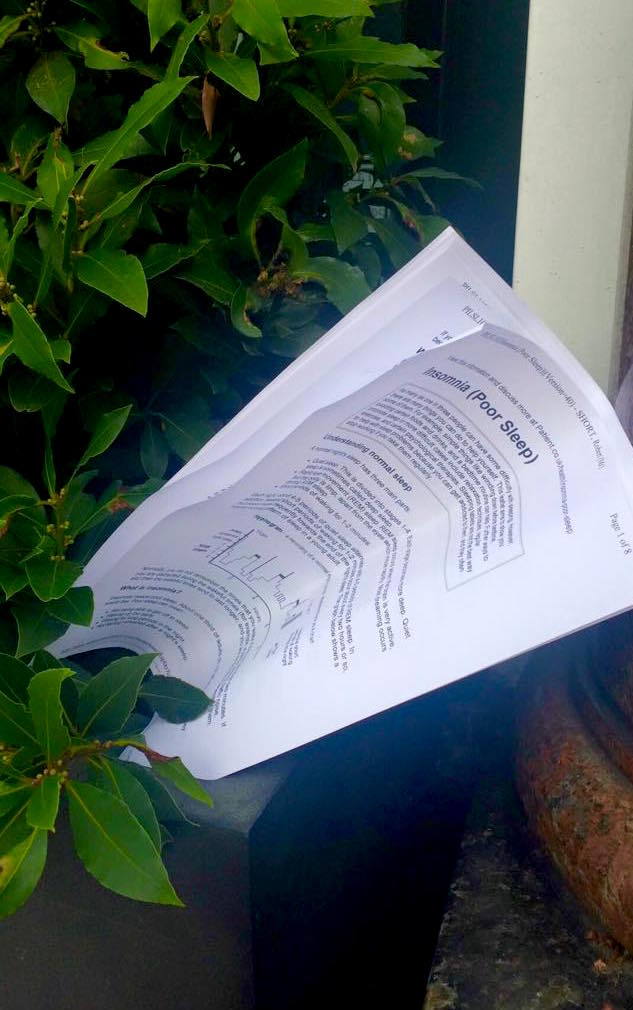
I wasn’t. But the whimsical quality of the moment stayed with me. And enough so that on my walk back to the office a little bit later, I noticed another anomaly: A bunch of papers stuck into the side of a plant pot, outside the White Horse pub. I read the first page visible.
Oh, and the book I’m reading? The People in the Trees by Hanya Yanagihara.
[Originally posted as part of my life.actually adventures]


January 31, 2011
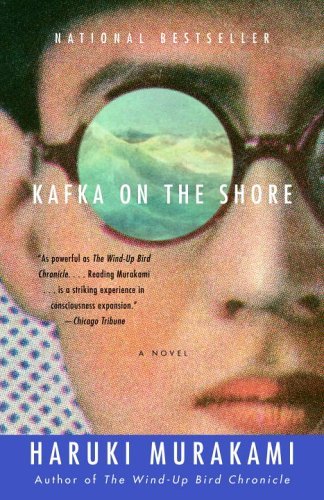
reason (n.) Kafka on the Shore review
I had a lovely Saturday this past weekend - finished off some work for school around 6pm and then decided to finish off the Murakami novel I've been reading... I lay into my super comfy couch and read for about half an hour and then was lulled to sleep with The Deep Dark Woods playing in the background. I can't remember the last time I napped so deeply - and man, did I enjoy it. Didn't even wake up groggy...
 Forty minutes later, I got up, fixed myself a huggggee coffee and excavated through the last twenty pages of Kafka on the Shore. It was fantastic(al). I had about an hour and a half before I was heading out for a friend's birthday so I did my best to make sense of a novel that according to its author,
"...contains several riddles, but there aren't any solutions provided. Instead several of these riddles combine, and through their interaction the possibility of a solution takes shape. And the form this solution takes will be different for each reader. To put it another way, the riddles function as part of the solution. It's hard to explain, but that's the kind of novel I set out to write."
(I won't keep quoting the genius man though - there's way too many blogs out there that keep referring to a certain interview with Haruki Murakami.)
So, great. I was left with questions that somehow amalgamate into a set of riddles - riddles that aren't even really clear, let alone their solutions. So, after turning the last page, Murakami planned to still require me to continue suspending my beliefs so that I could draw up a "reasoned" (or rather, "reasonable") solution.
You'd think that after 460 pages of suspending belief and growing accustomed to incestual relationships, fish raining from the sky, speaking cats, spirits roaming through forests and lots and lots of blood (sucked dry from wrists and gushing from feline intestines, you know, so you get the general idea) - you'd think after all that, coming up with a reasonable (i.e. insane) solution would be easy.
My first inclination was to be lazy and find someone else's answers and appropriate them to my own understanding of the book; however, what I found was an array of forums full of questions (like my own), reviews of a "dreamlike", "mindbending","tour de force", and a really snazzy author site - (which a lot of Flashdoesn't detract from, but rather, enhances the experience...)
So, in short, I found no answers out there so I had to figure it out for myself.
Stop reading now if you haven't read Kafka on the Shore - because you may think I've lost my mind. Instead, scroll down for some LOLcats.


Otherwise... Here's my take:
There's undoubtedly questions set up by the plot - the biggest one being, what constitutes a character, which extends to, who is who really? Understanding the duality of the characters helps justify their actions.
Simply, drawing from Shintoism I presume, is that a character is made up of the body and the spirit - read through the lenses of literal "bodily" conventions versus the metaphorical "spiritual" conceptualizations.
I gather that the entrance stone, when opened, allows spirits to move between bodies - and when closed, "logically", does not permit this movement... this is why a couple of characters (Nakata and Miss Seiki) die when the entrance stone is closed. I presume this is because they are not "complete" - Nakata's spirit moves into Hoshino because he is too weak/sleeping to close the stone, and Miss Seiki's spirit is in the spirit world, and so her body must die. You must have both aspects of "your"self in the literal/bodily world when the stone is closed because the spirits can no longer enter the living/bodily world (outside the forest) to fill the empty bodies...(?)
In general, it's confusing as to who is who when certain actions take place. In the literal world (of the reader and the logic set up external to the novel), the body trumps the spirit. This is why we initially feel uncomfortable dealing with events that take place that break down our expectations (like for example, Kafka sleeping with his mother and sister).
When Kafka sleeps with Miss Saeki, it is Kafka sleeping with his mother - but only as interpreted by "literal" or "bodily"- otherwise his body is just reuniting with the spirit of his mother. So, since the novel is working on several levels - the literal and the dreamlike spirit level - our literal, reading-selves feel very uncomfortable while our imaginative selves can interpret this differently: Kafka Tamura wants bodily attachment to his real mother, and the spirit inside him (the boy on the shore) is morally justified in partaking in the sexual act (with 15 year old Miss Seiki) and Kafka Tamura is jutified in reuniting with his mother on a spiritual level.
I digress. I can't handle explaining this in full sentences. So...
A confusing chronology (by me):
1. Hillside scene - kids fall unconscious. Nakata (body and mind) loses all his memory - Miss Saeki (body and mind) has opened the entrance stone to reunite with her lover - Kafka (the boy she saw on the shore).
2. Miss Seiki loses her spirit and becomes a hollow person in this world, working at the library with Oshima.
3. The body of Kafka Tamura leaves his home in search of his own spirit - which he finds at the library in Takmatsura (in the room with 15year old Miss Saeki; in effect, the spirit of Kafka Tamura is really the living spirit of Miss Seiki's lover, whose body was killed in university).
3.a. At this point, the real spirit of Kafka Tamura leaves his body and goes into Nakata. This is why Nakata and Kafka Tamura are both drawn toward each other, on parallel paths that eventually converge - on a spirital level - when the entrance stone is closed and things are "set straight".
4. Miss Saeki's spirit remains as a 15 year old girl (and appears in the room, where the body of Kafka Tamura sleeps with her - in his "dream" world).
4a. As such, Kafka Tamua's spirit has left his body (and gone into Nakata's body) and has been replaced by the Kafka on the shore's spirit - so he sleeps with what his body thinks is his mother.
5. Kafka Tamura's father's spirit takes shape as a concept - Johnnie Walker (his father is empty, mean, a hollow body, which is why they don't get along).
5a. Nakata (Kafka T's spirit) murders the Johnnie Walker (the spirit of Kafka T's father).
5b. Kafka Tamura reclaims his living spirit in the world, retains memories and escapes spirit forest before closing of the entrance stone.
6. Nakata is seeking to close the entrance stone in order to free the spirit of Kafka Tamura inside him - at the expense of Miss Saeki's bodily life, as her spirit will have to remain forever in the spirit world, making her body die. (When the entrance stone is closed, no longer can your body live without a spirit)
6a. As such, Nakata's body dies since his spirit is Kafka Tamura's spirit - which returns to Kafka Tamura when his bodily self overcomes the spirit inside him -Kafka on the shore- so his body returns to the bodily world, leaving the 15yr old Miss Saeki in the forest and acting as a transporter of Kafka on the shore's spirit (back to the spirit world). His body leaves to reclaim his own spirit (from Nakata).
7. Nakata's spirit goes into Hoshino (speaks to cats) and uses Hoshino's body to close the entrance stone. (Note: Nakata's spirit leaves him when he is "weak" and sleeps for long periods of time to become the concept, Colonel Sanders who guides Hoshino to complete the closing of the entrance stone mission).
I hope that made sense. Let's try and simplify it again:
When the entrance stone is opened:
spirit body
Kafka Tamura ----> Nakata and back to Kafka
Nakata ---> Coloner Sanders/Hoshino
Kafka on shore (lover)---> Kafka Tamura/ left in spirit world
Miss Saeki ---> 15 year old self in spirit world
(returns for a while, sleeps w.Kafka and then returns to the spirit world to tell Kafka to go back, reclaim his spirit and remember her forever.)
When the entrance stone is closed:
Miss Seiki and her lover are together in the spirit world (both bodies dead)
Nakata is dead and remembered forever by Hoshino (his spirit survives in him?)
Kafka has reunited his spirit with his body.
Lastly, Oshima and Sakura.... I gather neither is Kafka's truly sister - it would be too obvious. I actually believe that Kafka doesn't sleep with his real sister - which is a way to show that he was not necessarily led down an 'Oedipal' path, but that his projections about what 'fate' is are misguided; in fact, fate comes from the willpower of the spirits (the thing that Hoshino "kills" - the willpower of the spirits is effectively forbidden entry into the bodily world so that things can be restored (set 'straight').
Oshima is probably just a character presenting to us the possibility of duality even within the bodily aspect of ourselves to furhter break down the boundaries of our expectations and expected understandings...
Haha.. and stop. (TOtal geek out.)
[05.19.2011: I noticed this page is getting a lot of hits via searches about the book. I welcome comments and would love a discussion if it's compelling. Don't be scared, people-I-don't-know!]
"...contains several riddles, but there aren't any solutions provided. Instead several of these riddles combine, and through their interaction the possibility of a solution takes shape. And the form this solution takes will be different for each reader. To put it another way, the riddles function as part of the solution. It's hard to explain, but that's the kind of novel I set out to write."
(I won't keep quoting the genius man though - there's way too many blogs out there that keep referring to a certain interview with Haruki Murakami.)
So, great. I was left with questions that somehow amalgamate into a set of riddles - riddles that aren't even really clear, let alone their solutions. So, after turning the last page, Murakami planned to still require me to continue suspending my beliefs so that I could draw up a "reasoned" (or rather, "reasonable") solution.
You'd think that after 460 pages of suspending belief and growing accustomed to incestual relationships, fish raining from the sky, speaking cats, spirits roaming through forests and lots and lots of blood (sucked dry from wrists and gushing from feline intestines, you know, so you get the general idea) - you'd think after all that, coming up with a reasonable (i.e. insane) solution would be easy.
My first inclination was to be lazy and find someone else's answers and appropriate them to my own understanding of the book; however, what I found was an array of forums full of questions (like my own), reviews of a "dreamlike", "mindbending","tour de force", and a really snazzy author site - (which a lot of Flashdoesn't detract from, but rather, enhances the experience...)
So, in short, I found no answers out there so I had to figure it out for myself.
Stop reading now if you haven't read Kafka on the Shore - because you may think I've lost my mind. Instead, scroll down for some LOLcats.


Otherwise... Here's my take:
There's undoubtedly questions set up by the plot - the biggest one being, what constitutes a character, which extends to, who is who really? Understanding the duality of the characters helps justify their actions.
Simply, drawing from Shintoism I presume, is that a character is made up of the body and the spirit - read through the lenses of literal "bodily" conventions versus the metaphorical "spiritual" conceptualizations.
I gather that the entrance stone, when opened, allows spirits to move between bodies - and when closed, "logically", does not permit this movement... this is why a couple of characters (Nakata and Miss Seiki) die when the entrance stone is closed. I presume this is because they are not "complete" - Nakata's spirit moves into Hoshino because he is too weak/sleeping to close the stone, and Miss Seiki's spirit is in the spirit world, and so her body must die. You must have both aspects of "your"self in the literal/bodily world when the stone is closed because the spirits can no longer enter the living/bodily world (outside the forest) to fill the empty bodies...(?)
In general, it's confusing as to who is who when certain actions take place. In the literal world (of the reader and the logic set up external to the novel), the body trumps the spirit. This is why we initially feel uncomfortable dealing with events that take place that break down our expectations (like for example, Kafka sleeping with his mother and sister).
When Kafka sleeps with Miss Saeki, it is Kafka sleeping with his mother - but only as interpreted by "literal" or "bodily"- otherwise his body is just reuniting with the spirit of his mother. So, since the novel is working on several levels - the literal and the dreamlike spirit level - our literal, reading-selves feel very uncomfortable while our imaginative selves can interpret this differently: Kafka Tamura wants bodily attachment to his real mother, and the spirit inside him (the boy on the shore) is morally justified in partaking in the sexual act (with 15 year old Miss Seiki) and Kafka Tamura is jutified in reuniting with his mother on a spiritual level.
I digress. I can't handle explaining this in full sentences. So...
A confusing chronology (by me):
1. Hillside scene - kids fall unconscious. Nakata (body and mind) loses all his memory - Miss Saeki (body and mind) has opened the entrance stone to reunite with her lover - Kafka (the boy she saw on the shore).
2. Miss Seiki loses her spirit and becomes a hollow person in this world, working at the library with Oshima.
3. The body of Kafka Tamura leaves his home in search of his own spirit - which he finds at the library in Takmatsura (in the room with 15year old Miss Saeki; in effect, the spirit of Kafka Tamura is really the living spirit of Miss Seiki's lover, whose body was killed in university).
3.a. At this point, the real spirit of Kafka Tamura leaves his body and goes into Nakata. This is why Nakata and Kafka Tamura are both drawn toward each other, on parallel paths that eventually converge - on a spirital level - when the entrance stone is closed and things are "set straight".
4. Miss Saeki's spirit remains as a 15 year old girl (and appears in the room, where the body of Kafka Tamura sleeps with her - in his "dream" world).
4a. As such, Kafka Tamua's spirit has left his body (and gone into Nakata's body) and has been replaced by the Kafka on the shore's spirit - so he sleeps with what his body thinks is his mother.
5. Kafka Tamura's father's spirit takes shape as a concept - Johnnie Walker (his father is empty, mean, a hollow body, which is why they don't get along).
5a. Nakata (Kafka T's spirit) murders the Johnnie Walker (the spirit of Kafka T's father).
5b. Kafka Tamura reclaims his living spirit in the world, retains memories and escapes spirit forest before closing of the entrance stone.
6. Nakata is seeking to close the entrance stone in order to free the spirit of Kafka Tamura inside him - at the expense of Miss Saeki's bodily life, as her spirit will have to remain forever in the spirit world, making her body die. (When the entrance stone is closed, no longer can your body live without a spirit)
6a. As such, Nakata's body dies since his spirit is Kafka Tamura's spirit - which returns to Kafka Tamura when his bodily self overcomes the spirit inside him -Kafka on the shore- so his body returns to the bodily world, leaving the 15yr old Miss Saeki in the forest and acting as a transporter of Kafka on the shore's spirit (back to the spirit world). His body leaves to reclaim his own spirit (from Nakata).
7. Nakata's spirit goes into Hoshino (speaks to cats) and uses Hoshino's body to close the entrance stone. (Note: Nakata's spirit leaves him when he is "weak" and sleeps for long periods of time to become the concept, Colonel Sanders who guides Hoshino to complete the closing of the entrance stone mission).
I hope that made sense. Let's try and simplify it again:
When the entrance stone is opened:
spirit body
Kafka Tamura ----> Nakata and back to Kafka
Nakata ---> Coloner Sanders/Hoshino
Kafka on shore (lover)---> Kafka Tamura/ left in spirit world
Miss Saeki ---> 15 year old self in spirit world
(returns for a while, sleeps w.Kafka and then returns to the spirit world to tell Kafka to go back, reclaim his spirit and remember her forever.)
When the entrance stone is closed:
Miss Seiki and her lover are together in the spirit world (both bodies dead)
Nakata is dead and remembered forever by Hoshino (his spirit survives in him?)
Kafka has reunited his spirit with his body.
Lastly, Oshima and Sakura.... I gather neither is Kafka's truly sister - it would be too obvious. I actually believe that Kafka doesn't sleep with his real sister - which is a way to show that he was not necessarily led down an 'Oedipal' path, but that his projections about what 'fate' is are misguided; in fact, fate comes from the willpower of the spirits (the thing that Hoshino "kills" - the willpower of the spirits is effectively forbidden entry into the bodily world so that things can be restored (set 'straight').
Oshima is probably just a character presenting to us the possibility of duality even within the bodily aspect of ourselves to furhter break down the boundaries of our expectations and expected understandings...
Haha.. and stop. (TOtal geek out.)
[05.19.2011: I noticed this page is getting a lot of hits via searches about the book. I welcome comments and would love a discussion if it's compelling. Don't be scared, people-I-don't-know!]
December 29, 2010
bushwhack (v.)
My first encounter of "bushwhack" in a sentence came from my early childhood days spent at Camp Miriam, a wholesome, socialist-leaning, nature-loving, Jewish summer camp on Gabriola Island. Each age group (or "kvutzah" in Hebrew) had a daily branch of work (or "anaf avodah"), and mine was Anaf Bushwhacking.
My second encounter of bushwhacking was a week and a half ago when my boyfriend, Ben, and I were in Uclulet/Tofino. (It seems this bushwhacking thing and the Island are inseparable in my life.) Anyway, as I've mentioned, we attempted to go beach-combing in the morning (during low tide) at Schooner Cove, one day before our four year anniversary. After a nice one hour walk down the beach, kicking logs and sipping coffee from our tumblers, we decided it was time to head back.
However, seeing we'd only walked down and not back at all for the entire time, we were a few kilometres short of being anywhere near the (only) trail back to our car, the highway, the town, and well, civilization.
Before we knew it, our little stroll amounted to me running for my life toward shore after the tide came back and the ocean filled my Timberland boots and soaked me to my knees. So much for waterproof.
To avoid the waves that were crashing into the cliffy shoreline (and out to get us), we had to climb - yes, literally climb - into the forest.
I was in a frenzy, shaking from the cold that was climbing up from my frozen feet, and totally paranoid that the ocean was gonna take us in alive. I kept looking at the ground, the dirt and the branches all mushed together beneath my feet, and whenever I saw shells, I kept screaming to Ben, "Keep climbing higher!! It's moving fast! It's coming for us and it's gonna get us here!"
To say the least, fear makes you crazy. In retrospect, though, the only image I have from this moment was cliffs and slippery rocks in front of me as I quickly skittered across them, and Ben, scurrying along behind me, a tumbler in each hand high above above his head.
Once the shells in the dirt disappeared, and the ocean waves sounded far behind us, we calmed down a bit. This only lasted for a moment, though. It's hard to remain calm when you look around yourself and all you see are dense trees, storm debris, and no sign of human life (apart from the odd Birkenstock that just brings up images of a castaway's death).
We started walking. Well, hiking, climbing, crawling, and (wait for it)... bushwhacking.
 I'd never in my life realized what a real forest really looks like, how unpredictable terrain can be, and how utterly exhausting it is to move through it. There were tricks we developed. From staying low when the brush was high, to moving backwards to keep branches from hitting us in the face. Ben found it easier to move forward once he put the tumblers in his backpack and I found it easier to keep going by yelling at him. I threatened to kill him if a cougar didn't first. I blamed him for not bushwhacking fast enough (to beat the dark), or bushwhacking with too much gusto (for fear he'd get hurt and I'd have to drag his 6-foot self through the forest alone).
My favourite plant was soon the fern because it signalled easy terrain and no swampland or thick brush.
 After walking for an hour, we lost all orientation. It sounded like the ocean was surrounding us (which we later found was true because we'd reached the end of a small peninsula). We eventually called 9-1-1 (as my cell phone blinked "low battery"); while Ben gave out our information (B-E-N...May 2nd..... Vancouver... V-I-S-N....), I imagined our names in the paper: Due to a freak accident on Vancouver Island, Visnja, 23, and Ben, 25, were.... I didn't dare finish the thought.
Eventually, the operator put us through to the local Constable (Our Saviour!) who then told us we had two choices: 1: Wait at least five hours (two of which would be in the dark!) until the low tide came back; or 2: bushwhack.
Seeing I was not going to listen to animal sounds, freezing my butt off in a dark forest, we moved forward. To gain orientation, Constable B. played his car siren at the reservation close to the trail we were aiming for. Every couple of minutes, we'd stand in silence, our ears perked up listening for the sound of our target.
 Luckily, we weren't hurt. We sang together loudly (the silver lining) to keep the wildlife away (yikes) and tried to stay positive. Three and a half hours later, I, covered in mud and twigs, and Ben, with rain pants ripped to shreds, set foot on the trail.
Down the trail we saw Constable B. He looked back at us and smiled, then uttered a simple "fuck".
After a short car ride in the back of a police car, and another short drive back to our place in Uclulet, we realized how exhausted we were from our four hour trek. Never in my life had I tried so hard to move 1 km/hr.
 Once at the condo, Ben had to actually hose down our clothes. We left everything at the door (our muddy clothes and our negative feelings). Soon we were sipping rum and egg nog in front of the fire sighing over what had happened. Ben even looked at me with a smile saying, "When you said we weren't going to make it to our four-year anniversary, was that because you were going to break up with me or because you thought we were gonna die?"
I didn't bother replying and just gulped my drink, pulling twigs out of my hair.
 That night we had a burger and wings and fries and clam chowder and a whole lot of beer. We also sang karaoke.
We had a whole new appetite for life.
Happy Anniversary, baby!

 |
| Ben, before the real tumbling. |
However, seeing we'd only walked down and not back at all for the entire time, we were a few kilometres short of being anywhere near the (only) trail back to our car, the highway, the town, and well, civilization.
 |
| Just a stroll. |
To avoid the waves that were crashing into the cliffy shoreline (and out to get us), we had to climb - yes, literally climb - into the forest.
I was in a frenzy, shaking from the cold that was climbing up from my frozen feet, and totally paranoid that the ocean was gonna take us in alive. I kept looking at the ground, the dirt and the branches all mushed together beneath my feet, and whenever I saw shells, I kept screaming to Ben, "Keep climbing higher!! It's moving fast! It's coming for us and it's gonna get us here!"
To say the least, fear makes you crazy. In retrospect, though, the only image I have from this moment was cliffs and slippery rocks in front of me as I quickly skittered across them, and Ben, scurrying along behind me, a tumbler in each hand high above above his head.
Once the shells in the dirt disappeared, and the ocean waves sounded far behind us, we calmed down a bit. This only lasted for a moment, though. It's hard to remain calm when you look around yourself and all you see are dense trees, storm debris, and no sign of human life (apart from the odd Birkenstock that just brings up images of a castaway's death).
We started walking. Well, hiking, climbing, crawling, and (wait for it)... bushwhacking.
 I'd never in my life realized what a real forest really looks like, how unpredictable terrain can be, and how utterly exhausting it is to move through it. There were tricks we developed. From staying low when the brush was high, to moving backwards to keep branches from hitting us in the face. Ben found it easier to move forward once he put the tumblers in his backpack and I found it easier to keep going by yelling at him. I threatened to kill him if a cougar didn't first. I blamed him for not bushwhacking fast enough (to beat the dark), or bushwhacking with too much gusto (for fear he'd get hurt and I'd have to drag his 6-foot self through the forest alone).
 My favourite plant was soon the fern because it signalled easy terrain and no swampland or thick brush.
 After walking for an hour, we lost all orientation. It sounded like the ocean was surrounding us (which we later found was true because we'd reached the end of a small peninsula). We eventually called 9-1-1 (as my cell phone blinked "low battery"); while Ben gave out our information (B-E-N...May 2nd..... Vancouver... V-I-S-N....), I imagined our names in the paper: Due to a freak accident on Vancouver Island, Visnja, 23, and Ben, 25, were.... I didn't dare finish the thought.
Eventually, the operator put us through to the local Constable (Our Saviour!) who then told us we had two choices: 1: Wait at least five hours (two of which would be in the dark!) until the low tide came back; or 2: bushwhack.
Seeing I was not going to listen to animal sounds, freezing my butt off in a dark forest, we moved forward. To gain orientation, Constable B. played his car siren at the reservation close to the trail we were aiming for. Every couple of minutes, we'd stand in silence, our ears perked up listening for the sound of our target.
 Luckily, we weren't hurt. We sang together loudly (the silver lining) to keep the wildlife away (yikes) and tried to stay positive. Three and a half hours later, I, covered in mud and twigs, and Ben, with rain pants ripped to shreds, set foot on the trail.
Down the trail we saw Constable B. He looked back at us and smiled, then uttered a simple "fuck".
After a short car ride in the back of a police car, and another short drive back to our place in Uclulet, we realized how exhausted we were from our four hour trek. Never in my life had I tried so hard to move 1 km/hr.
 Once at the condo, Ben had to actually hose down our clothes. We left everything at the door (our muddy clothes and our negative feelings). Soon we were sipping rum and egg nog in front of the fire sighing over what had happened. Ben even looked at me with a smile saying, "When you said we weren't going to make it to our four-year anniversary, was that because you were going to break up with me or because you thought we were gonna die?"
I didn't bother replying and just gulped my drink, pulling twigs out of my hair.

We had a whole new appetite for life.
Happy Anniversary, baby!
December 27, 2010
beach combing (v.)
Ah, the art of beach combing - or perhaps the art that comes of it. It's a pretty neat activity that many people take part in while they're on the Westcoast, especially on Vancouver Island. Many people try to accumulate enough cool stuff to make art pieces (including picture frames and jewellery), but most take part in the hopes of clearing the beaches of unnaturally beach-occurring stuff.
Cool finds:
- shoes (hopefully, foot-free)
- boxes of high quality merchandise from China lost at sea that fell off of freighters (like boxes of shoes).
- beer bottles, beer cans, beer bongs, beer caps, lots and lots of beer stuff.
- plastic bottle caps (it's always disappointing).
- These awesome Japanese glass floats or buoys, from as early as the 30s (read about them here), which some persistent beachcombers spend their entire lives hoping to find. They're worth a pretty penny but no true beachcomber would sell it if they stumbled across one.
- poles, tubes, and other phallic objects.
- shipping pallets, or at least pieces of them (not that exciting seeing there's plenty of timber around anyway).
- nets, hooks, and other fishing/aquatic equipment) & boat parts (even motors).
- lots and lots of dead sea stuff (that still looks alive).
With all this adventuresome opportunity, my boyfriend Ben and I ventured out to Schooner Cove to partake in this island hobby.
However, much to our chagrin, we wound up bushwhacking.
Stay tuned.
Cool finds:
- shoes (hopefully, foot-free)
- boxes of high quality merchandise from China lost at sea that fell off of freighters (like boxes of shoes).
- beer bottles, beer cans, beer bongs, beer caps, lots and lots of beer stuff.
- plastic bottle caps (it's always disappointing).
 |
| Japanese glass float |
- poles, tubes, and other phallic objects.
- shipping pallets, or at least pieces of them (not that exciting seeing there's plenty of timber around anyway).
- nets, hooks, and other fishing/aquatic equipment) & boat parts (even motors).
- lots and lots of dead sea stuff (that still looks alive).
With all this adventuresome opportunity, my boyfriend Ben and I ventured out to Schooner Cove to partake in this island hobby.
However, much to our chagrin, we wound up bushwhacking.
Stay tuned.
Subscribe to:
Posts (Atom)