
I've moved my blog to WP: idefiningi.wordpress.com
January 31, 2011
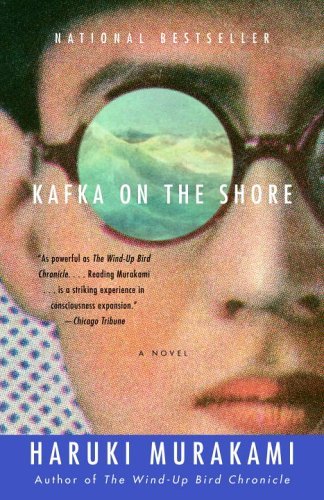
reason (n.) Kafka on the Shore review
I had a lovely Saturday this past weekend - finished off some work for school around 6pm and then decided to finish off the Murakami novel I've been reading... I lay into my super comfy couch and read for about half an hour and then was lulled to sleep with The Deep Dark Woods playing in the background. I can't remember the last time I napped so deeply - and man, did I enjoy it. Didn't even wake up groggy...
 Forty minutes later, I got up, fixed myself a huggggee coffee and excavated through the last twenty pages of Kafka on the Shore. It was fantastic(al). I had about an hour and a half before I was heading out for a friend's birthday so I did my best to make sense of a novel that according to its author,
"...contains several riddles, but there aren't any solutions provided. Instead several of these riddles combine, and through their interaction the possibility of a solution takes shape. And the form this solution takes will be different for each reader. To put it another way, the riddles function as part of the solution. It's hard to explain, but that's the kind of novel I set out to write."
(I won't keep quoting the genius man though - there's way too many blogs out there that keep referring to a certain interview with Haruki Murakami.)
So, great. I was left with questions that somehow amalgamate into a set of riddles - riddles that aren't even really clear, let alone their solutions. So, after turning the last page, Murakami planned to still require me to continue suspending my beliefs so that I could draw up a "reasoned" (or rather, "reasonable") solution.
You'd think that after 460 pages of suspending belief and growing accustomed to incestual relationships, fish raining from the sky, speaking cats, spirits roaming through forests and lots and lots of blood (sucked dry from wrists and gushing from feline intestines, you know, so you get the general idea) - you'd think after all that, coming up with a reasonable (i.e. insane) solution would be easy.
My first inclination was to be lazy and find someone else's answers and appropriate them to my own understanding of the book; however, what I found was an array of forums full of questions (like my own), reviews of a "dreamlike", "mindbending","tour de force", and a really snazzy author site - (which a lot of Flashdoesn't detract from, but rather, enhances the experience...)
So, in short, I found no answers out there so I had to figure it out for myself.
Stop reading now if you haven't read Kafka on the Shore - because you may think I've lost my mind. Instead, scroll down for some LOLcats.


Otherwise... Here's my take:
There's undoubtedly questions set up by the plot - the biggest one being, what constitutes a character, which extends to, who is who really? Understanding the duality of the characters helps justify their actions.
Simply, drawing from Shintoism I presume, is that a character is made up of the body and the spirit - read through the lenses of literal "bodily" conventions versus the metaphorical "spiritual" conceptualizations.
I gather that the entrance stone, when opened, allows spirits to move between bodies - and when closed, "logically", does not permit this movement... this is why a couple of characters (Nakata and Miss Seiki) die when the entrance stone is closed. I presume this is because they are not "complete" - Nakata's spirit moves into Hoshino because he is too weak/sleeping to close the stone, and Miss Seiki's spirit is in the spirit world, and so her body must die. You must have both aspects of "your"self in the literal/bodily world when the stone is closed because the spirits can no longer enter the living/bodily world (outside the forest) to fill the empty bodies...(?)
In general, it's confusing as to who is who when certain actions take place. In the literal world (of the reader and the logic set up external to the novel), the body trumps the spirit. This is why we initially feel uncomfortable dealing with events that take place that break down our expectations (like for example, Kafka sleeping with his mother and sister).
When Kafka sleeps with Miss Saeki, it is Kafka sleeping with his mother - but only as interpreted by "literal" or "bodily"- otherwise his body is just reuniting with the spirit of his mother. So, since the novel is working on several levels - the literal and the dreamlike spirit level - our literal, reading-selves feel very uncomfortable while our imaginative selves can interpret this differently: Kafka Tamura wants bodily attachment to his real mother, and the spirit inside him (the boy on the shore) is morally justified in partaking in the sexual act (with 15 year old Miss Seiki) and Kafka Tamura is jutified in reuniting with his mother on a spiritual level.
I digress. I can't handle explaining this in full sentences. So...
A confusing chronology (by me):
1. Hillside scene - kids fall unconscious. Nakata (body and mind) loses all his memory - Miss Saeki (body and mind) has opened the entrance stone to reunite with her lover - Kafka (the boy she saw on the shore).
2. Miss Seiki loses her spirit and becomes a hollow person in this world, working at the library with Oshima.
3. The body of Kafka Tamura leaves his home in search of his own spirit - which he finds at the library in Takmatsura (in the room with 15year old Miss Saeki; in effect, the spirit of Kafka Tamura is really the living spirit of Miss Seiki's lover, whose body was killed in university).
3.a. At this point, the real spirit of Kafka Tamura leaves his body and goes into Nakata. This is why Nakata and Kafka Tamura are both drawn toward each other, on parallel paths that eventually converge - on a spirital level - when the entrance stone is closed and things are "set straight".
4. Miss Saeki's spirit remains as a 15 year old girl (and appears in the room, where the body of Kafka Tamura sleeps with her - in his "dream" world).
4a. As such, Kafka Tamua's spirit has left his body (and gone into Nakata's body) and has been replaced by the Kafka on the shore's spirit - so he sleeps with what his body thinks is his mother.
5. Kafka Tamura's father's spirit takes shape as a concept - Johnnie Walker (his father is empty, mean, a hollow body, which is why they don't get along).
5a. Nakata (Kafka T's spirit) murders the Johnnie Walker (the spirit of Kafka T's father).
5b. Kafka Tamura reclaims his living spirit in the world, retains memories and escapes spirit forest before closing of the entrance stone.
6. Nakata is seeking to close the entrance stone in order to free the spirit of Kafka Tamura inside him - at the expense of Miss Saeki's bodily life, as her spirit will have to remain forever in the spirit world, making her body die. (When the entrance stone is closed, no longer can your body live without a spirit)
6a. As such, Nakata's body dies since his spirit is Kafka Tamura's spirit - which returns to Kafka Tamura when his bodily self overcomes the spirit inside him -Kafka on the shore- so his body returns to the bodily world, leaving the 15yr old Miss Saeki in the forest and acting as a transporter of Kafka on the shore's spirit (back to the spirit world). His body leaves to reclaim his own spirit (from Nakata).
7. Nakata's spirit goes into Hoshino (speaks to cats) and uses Hoshino's body to close the entrance stone. (Note: Nakata's spirit leaves him when he is "weak" and sleeps for long periods of time to become the concept, Colonel Sanders who guides Hoshino to complete the closing of the entrance stone mission).
I hope that made sense. Let's try and simplify it again:
When the entrance stone is opened:
spirit body
Kafka Tamura ----> Nakata and back to Kafka
Nakata ---> Coloner Sanders/Hoshino
Kafka on shore (lover)---> Kafka Tamura/ left in spirit world
Miss Saeki ---> 15 year old self in spirit world
(returns for a while, sleeps w.Kafka and then returns to the spirit world to tell Kafka to go back, reclaim his spirit and remember her forever.)
When the entrance stone is closed:
Miss Seiki and her lover are together in the spirit world (both bodies dead)
Nakata is dead and remembered forever by Hoshino (his spirit survives in him?)
Kafka has reunited his spirit with his body.
Lastly, Oshima and Sakura.... I gather neither is Kafka's truly sister - it would be too obvious. I actually believe that Kafka doesn't sleep with his real sister - which is a way to show that he was not necessarily led down an 'Oedipal' path, but that his projections about what 'fate' is are misguided; in fact, fate comes from the willpower of the spirits (the thing that Hoshino "kills" - the willpower of the spirits is effectively forbidden entry into the bodily world so that things can be restored (set 'straight').
Oshima is probably just a character presenting to us the possibility of duality even within the bodily aspect of ourselves to furhter break down the boundaries of our expectations and expected understandings...
Haha.. and stop. (TOtal geek out.)
[05.19.2011: I noticed this page is getting a lot of hits via searches about the book. I welcome comments and would love a discussion if it's compelling. Don't be scared, people-I-don't-know!]
"...contains several riddles, but there aren't any solutions provided. Instead several of these riddles combine, and through their interaction the possibility of a solution takes shape. And the form this solution takes will be different for each reader. To put it another way, the riddles function as part of the solution. It's hard to explain, but that's the kind of novel I set out to write."
(I won't keep quoting the genius man though - there's way too many blogs out there that keep referring to a certain interview with Haruki Murakami.)
So, great. I was left with questions that somehow amalgamate into a set of riddles - riddles that aren't even really clear, let alone their solutions. So, after turning the last page, Murakami planned to still require me to continue suspending my beliefs so that I could draw up a "reasoned" (or rather, "reasonable") solution.
You'd think that after 460 pages of suspending belief and growing accustomed to incestual relationships, fish raining from the sky, speaking cats, spirits roaming through forests and lots and lots of blood (sucked dry from wrists and gushing from feline intestines, you know, so you get the general idea) - you'd think after all that, coming up with a reasonable (i.e. insane) solution would be easy.
My first inclination was to be lazy and find someone else's answers and appropriate them to my own understanding of the book; however, what I found was an array of forums full of questions (like my own), reviews of a "dreamlike", "mindbending","tour de force", and a really snazzy author site - (which a lot of Flashdoesn't detract from, but rather, enhances the experience...)
So, in short, I found no answers out there so I had to figure it out for myself.
Stop reading now if you haven't read Kafka on the Shore - because you may think I've lost my mind. Instead, scroll down for some LOLcats.


Otherwise... Here's my take:
There's undoubtedly questions set up by the plot - the biggest one being, what constitutes a character, which extends to, who is who really? Understanding the duality of the characters helps justify their actions.
Simply, drawing from Shintoism I presume, is that a character is made up of the body and the spirit - read through the lenses of literal "bodily" conventions versus the metaphorical "spiritual" conceptualizations.
I gather that the entrance stone, when opened, allows spirits to move between bodies - and when closed, "logically", does not permit this movement... this is why a couple of characters (Nakata and Miss Seiki) die when the entrance stone is closed. I presume this is because they are not "complete" - Nakata's spirit moves into Hoshino because he is too weak/sleeping to close the stone, and Miss Seiki's spirit is in the spirit world, and so her body must die. You must have both aspects of "your"self in the literal/bodily world when the stone is closed because the spirits can no longer enter the living/bodily world (outside the forest) to fill the empty bodies...(?)
In general, it's confusing as to who is who when certain actions take place. In the literal world (of the reader and the logic set up external to the novel), the body trumps the spirit. This is why we initially feel uncomfortable dealing with events that take place that break down our expectations (like for example, Kafka sleeping with his mother and sister).
When Kafka sleeps with Miss Saeki, it is Kafka sleeping with his mother - but only as interpreted by "literal" or "bodily"- otherwise his body is just reuniting with the spirit of his mother. So, since the novel is working on several levels - the literal and the dreamlike spirit level - our literal, reading-selves feel very uncomfortable while our imaginative selves can interpret this differently: Kafka Tamura wants bodily attachment to his real mother, and the spirit inside him (the boy on the shore) is morally justified in partaking in the sexual act (with 15 year old Miss Seiki) and Kafka Tamura is jutified in reuniting with his mother on a spiritual level.
I digress. I can't handle explaining this in full sentences. So...
A confusing chronology (by me):
1. Hillside scene - kids fall unconscious. Nakata (body and mind) loses all his memory - Miss Saeki (body and mind) has opened the entrance stone to reunite with her lover - Kafka (the boy she saw on the shore).
2. Miss Seiki loses her spirit and becomes a hollow person in this world, working at the library with Oshima.
3. The body of Kafka Tamura leaves his home in search of his own spirit - which he finds at the library in Takmatsura (in the room with 15year old Miss Saeki; in effect, the spirit of Kafka Tamura is really the living spirit of Miss Seiki's lover, whose body was killed in university).
3.a. At this point, the real spirit of Kafka Tamura leaves his body and goes into Nakata. This is why Nakata and Kafka Tamura are both drawn toward each other, on parallel paths that eventually converge - on a spirital level - when the entrance stone is closed and things are "set straight".
4. Miss Saeki's spirit remains as a 15 year old girl (and appears in the room, where the body of Kafka Tamura sleeps with her - in his "dream" world).
4a. As such, Kafka Tamua's spirit has left his body (and gone into Nakata's body) and has been replaced by the Kafka on the shore's spirit - so he sleeps with what his body thinks is his mother.
5. Kafka Tamura's father's spirit takes shape as a concept - Johnnie Walker (his father is empty, mean, a hollow body, which is why they don't get along).
5a. Nakata (Kafka T's spirit) murders the Johnnie Walker (the spirit of Kafka T's father).
5b. Kafka Tamura reclaims his living spirit in the world, retains memories and escapes spirit forest before closing of the entrance stone.
6. Nakata is seeking to close the entrance stone in order to free the spirit of Kafka Tamura inside him - at the expense of Miss Saeki's bodily life, as her spirit will have to remain forever in the spirit world, making her body die. (When the entrance stone is closed, no longer can your body live without a spirit)
6a. As such, Nakata's body dies since his spirit is Kafka Tamura's spirit - which returns to Kafka Tamura when his bodily self overcomes the spirit inside him -Kafka on the shore- so his body returns to the bodily world, leaving the 15yr old Miss Saeki in the forest and acting as a transporter of Kafka on the shore's spirit (back to the spirit world). His body leaves to reclaim his own spirit (from Nakata).
7. Nakata's spirit goes into Hoshino (speaks to cats) and uses Hoshino's body to close the entrance stone. (Note: Nakata's spirit leaves him when he is "weak" and sleeps for long periods of time to become the concept, Colonel Sanders who guides Hoshino to complete the closing of the entrance stone mission).
I hope that made sense. Let's try and simplify it again:
When the entrance stone is opened:
spirit body
Kafka Tamura ----> Nakata and back to Kafka
Nakata ---> Coloner Sanders/Hoshino
Kafka on shore (lover)---> Kafka Tamura/ left in spirit world
Miss Saeki ---> 15 year old self in spirit world
(returns for a while, sleeps w.Kafka and then returns to the spirit world to tell Kafka to go back, reclaim his spirit and remember her forever.)
When the entrance stone is closed:
Miss Seiki and her lover are together in the spirit world (both bodies dead)
Nakata is dead and remembered forever by Hoshino (his spirit survives in him?)
Kafka has reunited his spirit with his body.
Lastly, Oshima and Sakura.... I gather neither is Kafka's truly sister - it would be too obvious. I actually believe that Kafka doesn't sleep with his real sister - which is a way to show that he was not necessarily led down an 'Oedipal' path, but that his projections about what 'fate' is are misguided; in fact, fate comes from the willpower of the spirits (the thing that Hoshino "kills" - the willpower of the spirits is effectively forbidden entry into the bodily world so that things can be restored (set 'straight').
Oshima is probably just a character presenting to us the possibility of duality even within the bodily aspect of ourselves to furhter break down the boundaries of our expectations and expected understandings...
Haha.. and stop. (TOtal geek out.)
[05.19.2011: I noticed this page is getting a lot of hits via searches about the book. I welcome comments and would love a discussion if it's compelling. Don't be scared, people-I-don't-know!]


Subscribe to:
Post Comments (Atom)
Since I haven't read the book, the LOLcats were a "tour de force."
ReplyDeleteI'll lend it to you - if you dare.
ReplyDeleteGood explanation. I didn't get it that deep..
ReplyDeleteI do agree with your analysis of the plot, but where is Nakata's spirit during all of this? Is it lost to the forest/spirit land during the hillside scene? It makes sense to say that it transfers into Hoshino and the concept of Colonel Sanders but where is it before all that? This whole idea of switching spirits between bodies seems like the spirits have no choice where they go, and it is an unconscious thing. Plus, how are the half-shadows explained? Do Nakata and Miss Saeki have half shadows because they're "hollow"? It makes sense that Miss Saeki has a half shadow because her spirit is in the forest and her body hasn't been occupied by another spirit, but Nakata has been occupied by Kafka's living spirit, and so should have a full shadow? I don't know, maybe I'm reading way too much into it, but I just enjoyed the book so much and I'm trying to make sense of it all hahah!
ReplyDeleteIt's my first time reading a mind-boggling book such as this (but I'm loving it despite the whole confusion I had). This analysis helped me to have a better degree of understanding.
DeleteHmm, your answer to your own question seems legit haha. The spirits probably don't have much control to where they go. Nakata said he has half-shadow because he is hollow, and that spirits can easily take over his body. I guess even when his body was occupied by Kafka's spirit, he still has half-shadow, maybe because he is still not 'complete' because the spirit isn't his.
About Nakata's spirit, I think Nakata is a special case where his spirit didn't found its way back to his body whereas the other kids who were unconscious at the hill had their spirits normally return to themselves. I DON'T KNOW WHY THOUGH haha a little frustrated right here.
I also wonder if kafka's father actually killed cats? or if that's also just metaphorical? There was no report from the police about finding cats' heads in the fridge. What happened to that short chapter where Crow sort of pecked him until his whole face messed up? I'm not quite sure of that part. I initially thought Johnnie Walker was the white thing that Hoshino kills, since he's threatening. Well, he put curse on kafka and he killed cats to create soul-collecting flute, maybe if he entered the entrance stone, he would set things in chaos again?
Sorry, but I'm not so bright (quoting nakata) and I don't understand a lot of things, but for some reason I enjoy this book tremendously. Oshima and Hoshino are awesome by the way.
I was playing with the thought that Nakata's spirit didn't return back to its body after the incident, because it was damaged. I'm referring to the part where the teacher was describing Nakata (before the incident took place)as a very intelligent student, who however, lacked the typical cheerfulness that could be observed in other kids. He was suffering from the conditions and pressures that he was exposed to at home and I assume that he felt incredibly lonely, and naturally suffered from some kind of trust issues. As the teacher described, step by step, after long time he developed some sort of a closer relation to her. He started to trust and open up to her. I guess the crucial point or the final hit to his spirit came shortly before the accident - when the only person he could trust at least partially slapped him. I guess that was the point where his spirit broke and got so damaged that it didn't make its path back to its body afterwards.
DeleteI also think that Miss Saeki's spirit was damaged in a similar way, or at least she suffered from losing someone close to her and becoming endlessly lonely afterwards. There's a difference between them though, and that's that she had opened the Entrance Stone, and so unleashed her spirit on purpose.
Oh, and by the way, I have similar confusing thoughts about Kafka's father in this story.
That was great, I had alot of the same thoughts but you connected some of the dots I missed.
ReplyDeleteOnce you see Nakata as Kafka, it makes a lot of sense that Johnnie Walker is his father.
But the why was his father using a flute to collect cat souls? I am sure this has some connection to the entrance stone and the creature Hoshino "kills"
Thanks for your comments, fellow Murakamists.
ReplyDeleteC: I wonder whether some part of a being keeps it from ever being fully "filled" when love and heartbreak get involved...? If two spirits don't come together, the bodies can never have a full shadow?
RT: The cats...hmm.. I know Murakami loves cats, so perhaps he gave them some unique spiritual power, a kind which can be collected and used to control other spirits (hence the entrance stone)?
I think we'll all be rereading this one some time...and asking a whole new set of questions. :)
I just finished the book and as much as I enjoyed it, it confused me too. So your analysis helped me. A lot. And it makes me appreciate the book even more. Thanks!
ReplyDeleteYour analysis is very well thought out, but how could Saeki's opening of the entrance stone affect Nakata at the rice bowl incident if their ages are completely different. Saeki is described as a women in her 50 possibly early 60s and Nakata lives through WWII, how could she be a teenager at the time she opened the entrance stone if Nakata was around ten when the rice bowl incident occured?
ReplyDeleteThanks for your explanation.i only have more questions, many, but i'll limit it to two comments.
ReplyDelete1. i'm assuming miss saeki opened the stone at some time we were not told about, or was the teacher's dream about miss saeki's opening of the stone? The teacher's name was different, and her husband died in the war, not at tokyo uni. She dreamed about screwing on a stone. Was that related, I wonder. It seems a trivial detail among a lot of suspended disbelief.
2. For someone who loves cats, murakami seemed far too gratuitous for my tastes in the johnny walker scene. Frankly i found that so revolting i skipped over the words until I read "nakata stood up." He lost any of my fan-power in that scene, and I don't think he'll get it back. And wouldn't a row of catheads in the fridge have made the news report about the "sculptor's" death?
Just my 10c worth,
dee
When Miss Saeki opened the stone she was 15 years old and Nakata was a child...how come Nakata become very old when Saeki was only 50 years old?
ReplyDeleteGirl, don’t say you are not bright. I could not and I imagine a lot of us could have never figured out half the stuff you did. How did you do that?
ReplyDeleteThank you for sharing your thoughts. To be honest, I have read this book years ago and it is only now that it made sense to me seriously :)
ReplyDeleteThis is so helpful, thank you 🤍
ReplyDeleteWhy is there a blood stain on Kafka's shirt even though only his spirit went to Nakata?
ReplyDelete